How to Achieve Financial Freedom

Financial freedom. These two words can cause some major angst.

After all, who needs another reminder of the unattainable? With every scroll through Instagram, you witness people living their best lives. And maybe you’re left wondering how you’ll ever be able to pay for the life you’re living right now—much less the worry-free, Instagram-approved, easygoing financial existence you dream of.

Well, friends, we’re here to turn your head (and your heart!) back toward the dream of financial independence. We want you to find freedom from your past by paying off debt and to look forward to your future by building wealth.

Believe it or not, the key to finding financial freedom is simple: Keep a monthly budget.

The Opposite of Financial Freedom

When it comes to vetting the lifestyles of the rich and famous, social media only tells us half the story. The expensive cars, huge homes, and seldom-repeated outfits may very well be purchased through careless spending and the swipe of a credit card.

Studies help us gain a sense of reality about the financial stability of our neighbors:

  • 78% of U.S. workers live paycheck to paycheck.¹
  • Nearly 3 in 4 workers say they are in debt.²
  • Almost half of U.S. households carry credit card debt with an average balance of $15,654.³

Maybe some of these statistics ring true for you too. If so, you know what it’s like to always run out of money, regardless of how much you’re bringing in.

That’s because financial bondage doesn’t discriminate based on income. In fact, researchers found that one in 10 workers earning $100,000 or more live paycheck to paycheck. It’s no wonder that on average, 40% of Americans feel they have too much debt.

Do these numbers have you feeling all the feelings? Pause for a moment and take a deep breath. It helps to acknowledge where you’re at today. Mark this as your starting place and get ready to run in a different direction toward financial freedom.

How to Break the Cycle of Living Paycheck to Paycheck

Let’s call it like it is, shall we? The ability to take the first step toward financial freedom—and all the steps that come after—is up to you. It’s not up to your boss, a lottery ticket, your spouse, or your kids.

You’re the only one who can make decisions about how you’ll spend the money you earn (and earn the money you spend!) moving forward. Yes, it helps to have your spouse and your family on board. But you have to start with the one person you can control: yourself.

In order to get where you want to go, you’ll need a strategy. Let’s break it down into steps:

  1. Make a plan.
  2. Monitor the plan.
  3. Evaluate your plan and make adjustments.
  4. Rinse and repeat.

Study after study show that if we want to reach a big goal we should be intentional about tracking progress. Writing everything down really packs a punch. Researchers call this approach monitoring; we call it making a budget.

Makes sense, right? By putting together a plan for your money and checking in regularly, you’re bound to find all kinds of dollars floating around ready to be put to better use.

The monthly budget is a powerful tool. Just ask one of the four million (and counting!) budgeters that we know! Each one is working toward their own definition of financial freedom.

You Can Reach Financial Freedom Through Budgeting

Let’s talk about what we mean by a monthly budget. You can find a complete guide on our website. In the meantime, we’ll cover the basics:

  • Create your budget before the next month begins.
  • Include all income and all expenses.
  • Give every dollar a name.
  • Move things around until your income minus your expenses equals zero.
  • Track your spending as the month goes along.

That’s it!

When you budget this way, you have the opportunity to prioritize what’s most important. If you’re not sure what you should be focusing on, take a moment to determine where you are in the Baby Steps. Maybe you’d like to pay off debt, build an emergency fund, or save for an upcoming vacation or a new home.

Budgeting Changes EVERYTHING!

You can experience the benefits of budgeting—and get a taste for the financial freedom budgeting brings—long before you’re living the life of your dreams.

In fact, as we see it, budgeting produces financial freedom through three distinct phases. Here they are with tips on how to master each one:

Phase One: Take control of your finances.

That’s right. Financial freedom starts when you do.

  • With a budget you tell your money what to do instead of wondering where it went.
  • A budget gives you a starting point for money talks with your spouse and goal-setting for the months, years and decades ahead.
  • A budget helps you prioritize your spending appropriately.

Phase Two: Track your spending and stay the course.

Create and maintain a monthly budget, and you can’t help but accomplish great things.

  • A budget enables you to find money you didn’t know you had. Seriously. You can put that money toward things you actually care about like giving, saving or paying down debt.
  • Because the budget takes big picture goals and breaks them down into monthly increments, you’ll slowly but surely—or quickly and defiantly!—cross big items off your financial bucket list.
  • The longer you budget, the more you’ll love budgeting. It takes most users about three months to get the logistics down. After that, you can count on momentum to keep you moving.

Phase Three: Commit to budgeting for the long haul.

Make budgeting a lifestyle instead of a quick fix, and you’ll never look back.

  • A budget offers peace of mind no matter your circumstances. When tragedy strikes, you can focus on people instead of paperwork.
  • The monthly budget, practiced year after year, opens you up to give generously whenever a need arises.
  • Managing your money well with a budget prepares you to go wherever and do whatever you want. Limit, meet sky.

Budgets: Let’s Take a Closer Look at the Category of Giving

We all know January is the perfect time for a fresh start. You may have already jotted down a few 2018 goals or made resolutions to get healthier and kick bad habits. Good for you!

In the spirit of fresh starts, let’s begin this year the way we ended last year—by giving! Take a look at your budget and your giving habits in order to think about ways to amp up the generosity in 2018.

Here are two questions to get you started:

1. Do I give?

If the answer is yes, take a moment to think about your current giving. Consider the organizations you contribute to and the amount of your donations. Would you like to give more, give less, or give to a different charitable organization? Make a decision based on your budget.

If the answer is no, that’s okay! We’re not here to judge. We’re here to help. Determine why you don’t give and what you can do to overcome that hurdle:

  • I don’t give because I don’t have enough money: Start by donating your time. Then, slowly but sure, aim to give about 10% of your income away. You might need to first work to pay off debt, freeing up some of your income so that you can reach all of your money goals, including the hope of helping others.
  • I don’t give because I don’t know where to give: Look around you. Do you attend church? Could you ask around to find out what needs are present in your local community? What are you passionate about? With a little research you’re sure to find a way to make a difference.
  • I don’t give because it doesn’t cross my mind: Build giving into your budget. In fact, we suggest putting giving at the top of your budget, followed by saving, and then spending. Here, we already put the budget in this order so you’ll never forget!

2. What do I want to teach my children about giving?

This one gets us every time. Because when we frame our actions by what our kids see, we end up seeing ourselves more clearly.

Plus, kids are impressionable. They pick up on the bad, but they also remember the good. Take some time to think about the example you’re setting for the next generation. Are you encouraging generosity or greed?

And remember most kids from toddler to teen love to give, so look for ways to get the whole family involved. You can talk about how you include giving in your monthly budget—and why. Volunteering and donating your family time is also a great way to give. Spend time brainstorming where you’d like to volunteer.

Studies regularly show the benefits of being generous, including less stress, greater joy and a longer life.¹ Adding a giving category to your budget takes just minutes. Go ahead. Help others and yourself and receive year-round warm and fuzzies.

7 Steps to Your Dream Vacation

We all have dreams—both big and small. Dream jobs, dream dates, dream pets, dream accomplishments, and even dream vacations. Some of us leave our dreams in the clouds, while others run after them with vigor.

If you’ve been fantasizing about your ideal getaway for years, maybe it’s time to take action. And the only way to make any dream a reality is with proper planning. Proper plans fall into place when you ask and answer the right questions.

We’ve compiled a list of seven key questions to help you make your dream vacation a reality.

1. Where is my dream vacation destination?

To some, this may seem like the oddest question ever. After all, you’ve been imagining your ideal destination for the better part of your life. But for others, the answer is next to impossible because you want to go to all the places. So the first step is to narrow down your dreams to one achievable dream at a time.

As you envision your answer, remember the key word “dream.” You’ll work out the financial details later, so don’t limit yourself. And while you’re thinking, realize your answer to this question might be affected by your answer to the next.

2. Who’s coming with me?

Have you been talking about visiting your family roots in Ireland with parents and siblings? Have you and your spouse shared a desire to go on an Alaskan cruise for ages? Has your group of friends been saying “someday” about a week stay at a five-star ski resort? Maybe your dream vacation is a shared dream with loved ones.

Once you know who’s really in, you can do a better job of figuring out timing (based on schedules) and costs (based on dividing expenses).

3. When is the best timing for my dream vacation?

First, let’s be responsible. There’s no problem in dreaming big—especially when you’re ready to work hard saving up to make those big dreams come true. But if you haven’t finished up Baby Step 2 (paying off all your debt), you may want to enjoy a staycation for now. It doesn’t mean you can’t prepare for a huge reward trip after you’re debt-free. That’d be a great way to celebrate!

Next, when we’re talking about timing, there are a few things to factor in:

  • Time of Year

For example, if you’re going to Iceland to see the Northern Lights, don’t go in the summer—you won’t see them! Do some research to make sure you hit your dream spot in the right season for what you’re hoping to see and do.

  • Time Off

Depending on who’s involved, you might need to travel during certain parts of the year. Kids have a naturally obvious break in their school schedule, which makes summer trips easier to coordinate without piles of makeup work.

  • Time to Save

This is a dream vacation, not your typical weekend trip two towns over. You’re going to need time to save! It’s fine if you realize this trip will mean a year or more of stashing away cash. We’ll tell you how to budget and save over time.

4. What will this trip cost me?

Tally all the costs involved—airfare, car rentals, food, hotels or house rentals, attractions and activities, morning coffee runs, souvenirs (for yourselves and others), and so on. Some of these expenses (cars and living space) you’ll be able to divide among the others coming. The rest is up to you and your (perfectly prepared) wallet.

5. How do I budget for my dream vacation?

Once you have a total in mind, divide that cost by the number of months until you leave. This gives you what you’ll need to save each month. For example, let’s say you need $8,000 to take that once-in-a-lifetime European food tour in 15 months. With 15 months to save, that means stashing away $533 a month.

  • What happens if that number seems impossible for your budget? Take a moment to explore these possible solutions:
  • Extend your trips dates out. Using the example above, if you waited an additional year, you’d need to save just $297 each month.
  • Consider making some adjustments. Perhaps you’ll stay just 10 days instead of two weeks or skip out on an activity or two.
  • Stay serious as you save. Buckle down for the next 15 months—working and saving hard now so you can play hard later.
  • Search for thriftier options. Flying coach, renting more economical cars, reserving different living spaces: these are all ways to make the trip more affordable.

When you get to a number you know you can live with each month (even if it means living tighter), you’re ready to set up a fund in your budget. This feature helps you keep track of all the money you’re reserving for trip expenses. Here’s how:

  • Create a new budget line item titled “Dream Vacation.”
  • Choose to “Make this a Fund.”
  • Enter your savings goal of $8,000 and save!

You now have a fund for your trip! Each month, enter the planned amount of $533 (or $297, or whatever you ended up with) and transfer that amount to a savings account. It should be easy to keep track of your progress, and you can check in anytime to see how you’re doing.

6. How do I save for my dream vacation?

When you need to find extra money in your budget, the first place you need to go is, well, your budget. Start by looking for any extraneous spending. Can you scale back on buying clothes for a few months, eat out less, or drop a few memberships you no longer want or need? You’ll be surprised how quickly little changes add up—and how much they’ll contribute to a better, even more fantastic getaway.

7. Where do I start my search for great getaway deals and discounts?

Go line by line on each part of your planned trip and see where you can get special deals—from airline tickets to local attractions to lunch at a seaside restaurant. Then sign up for emails and text alerts about discounts.

Check out AirfareWatchdog for plane ticket alerts, Hipmunk for hotel and lodging costs, and GasBuddy for the best gas prices. Who knows? You may come in under budget and have even more to spend on your special getaway adventure!

You can do it. When times get hard, just think about the reward of lying on the beach or sitting at a Parisian café at sunset on a vacation that is already paid for! You’ll bring home all the memories and none of the debt. Now that’s a real dream come true.

How to Budget for Unexpected Expenses

Every morning, budgeting friends, we all wake up, lace our shoes, and hit the ground running. Money goals? We’re gettin’ after ’em. Temptations? Out of our way.

But then . . .

Sometimes we hit the wall of unexpected expenses. And it feels like one step forward and 22 steps backward with money plans out the window. After all, we can’t anticipate what we don’t see coming.

Or can we?

The best—and maybe only—way to stick to a budget when unexpected expenses pop up is to expect them. Don’t wait for sneaky bills or last-minute obligations to find you. Be on the lookout! Make room for unexpected expenses, and instead of hitting a wall, you can hop a hurdle. Don’t worry. We’ll show you how.

Are Your Expenses Unexpected or Overlooked?

Let’s play a little game called Unexpected or Overlooked? Cue theme music. Are you ready? It’s 2:00 p.m. on a Saturday and you just cozied up on the couch with a good book when . . . dingdong! It’s your mother-in-law!

Unexpected or overlooked?

Sure, you didn’t know she was coming today, but did you think she’d never visit? Quick! Slip the sweater she made on little Johnny and serve some of that coffee she loves—the kind you keep in the pantry for such a time as this. (Look at you go!)

This is the same game we play with our budget. Most of our surprise costs aren’t unexpected. They’re just overlooked. We’re talking field trips, vacations, birthday parties, annual membership fees, car repairs and, yeah, even out-of-the-blue guests.

You can plan for all of these things just like you plan for your mother-in-law. Sit down with your spouse or accountability partner and talk through expenses that might come up over the course of a year. And we mean everything. There’s no wrong answer here—this is an opportunity to get all of your unexpected and overlooked expenses on the table.

Of course, there will be times when an expense catches you completely off guard. We’ll talk about that later. But for now, let’s look at some of the so-called unexpected expenses you might want to add to your list.

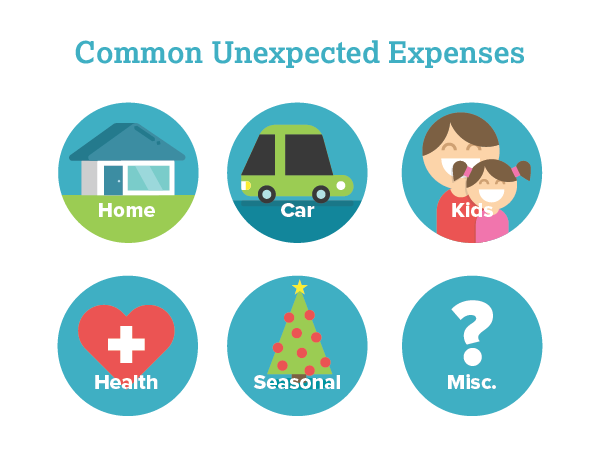
Common Overlooked Expenses: Home, Car, Kids, Health, Seasonal, Misc.

List Your Possible Overlooked Expenses

When brainstorming overlooked expenses, think of them by category. Our categories are below, but feel free to come up with your own! Add to our list, cross off items that don’t apply to you, and work until you’ve exhausted every corner of possibility.

1. Home: maintenance and upkeep, quarterly bills, property taxes, pest control, furniture replacement, moving costs and appliance repair.

2. Cars: maintenance and repairs, tires, oil change, car tag, toll fees and traffic tickets.

3. Kids: new clothes, field trips, birthday gifts, school supplies and extracurricular activities.

4. Health: co-pay for doctor’s visits, medicine and prescriptions, new glasses or contacts, braces, birth of a new baby, and maternity leave.

5. Seasonal: landscaping, summer and holiday travel, Christmas gifts, Halloween costumes, and outings with family, coworkers or friends.

6. Miscellaneous: repairing and replacing phones or computers, pet care, annual membership fees, weekend guests, baby shower gifts and wedding travel.

Build Forgotten Expenses Into Your Budget

List in hand, you now hold a key to your financial future. All you need to do is put your knowledge to work in the following ways:

1. Estimate your overlooked expenses. Go down your list to determine how much each item will cost over the course of one year.

You may be guessing on many of these, so do your best to make educated guesses—look back at past years, contact the car repair company, or do a little research online. For things within your control, like gifts and landscaping, set a limit that seems reasonable.

Divide each yearly total by 12—that’s the amount you should save each month for those expenses. Now you won’t feel pummeled by big charges all at once.

Important to note: Change the math for expenses that are just around the corner. If, for example, you’re beginning this process in October and need to save $600 by Christmas, you’ll want to divide your total by three instead of 12. Set aside $200 a month between now and December and pay for your gifts with cash!

2. Set up a sinking fund. Not sure what we mean by sinking fund? A sinking fund allows you to slowly save up for a specific item you know you’ll need in the future. For example, you may want to buy a new car next year. If the car you want is $6,000, you’ll need to put $500 a month in your sinking fund to be ready for that purchase.

With a sinking fund, you can build overlooked-but-not-unexpected expenses right into your budget and keep track of how much you’re saving as the year goes by. Simply create budget categories for each item and select the drop-down menu for “fund” on the right. You can enter how much you’ve saved so far and how much you’d like to save overall.

When setting up your funds, try to lump a few items into one category. For instance, if you don’t have a Health Savings Account (HSA) you could create a “health” category for copays, prescriptions, glasses and contacts. But your 11-year-old and her braces are on their own—their own category anyway.

Important to note: Put your sinking fund money in a safe spot with easy access. A checking account or a savings account with check-writing privileges should do the job.

An Emergency Fund Keeps Unplanned Expenses From Derailing Your Money Goals

An Emergency Fund Keeps Unplanned Expenses From Derailing Your Money Goals

What about those expenses that are truly unexpected, like an accident or a layoff?

Sometimes the walls we hit really are walls, and there’s no hopping over them. A recent survey found that it would take just $500 in unexpected expenses to wipe out the cash supply of most American households.¹ You can blow through $500 quickly with a faulty HVAC unit or a major illness. That’s why we all need an emergency fund.

An emergency fund is money set aside for—you guessed it!—emergencies. We recommend starting with a beginner emergency fund of $1,000. From there, once you’re debt-free, move on to a fully funded emergency fund covering three to six months of your current expenses.

What to Do When an Unplanned Expense Hits

You’re all set with a sinking fund built into your budget and a growing emergency fund at the ready. Here’s what you should do when an out-of-the-ordinary expense comes your way.

1. Do you have the money set aside in a sinking fund? Pay up and smile. That was easy.

2. No money planned for this one? Ask yourself these questions—and look for all yeses—before raiding your emergency fund:

  • Is it unexpected? (Overlooked doesn’t count here.)
  • Is it absolutely necessary?
  • Is it urgent?

Example: Needing to repair the furnace in the middle of winter is unexpected, urgent and absolutely necessary, but wanting to redo an ugly-but-functional bathroom is not. Start a sinking fund for the bathroom and use your emergency fund for the furnace.

3. Don’t have the money but it doesn’t qualify for emergency-fund status? Try one of these options on for size:

  • Get by while you save up.
  • Shop around for a better price.

Example: If your phone screen is cracked, use it while you save up for a new phone. In the meantime, shop around for the best price on a new phone or even a repair.

4. Make a note of the actual cost. Use this knowledge to adjust your savings moving forward.

5 Reasons Why Budgeting is Right For You

When it comes to relationships, we all expect a little give and take. Even the parent of a toddler knows that a day beginning with tantrums and negotiations ends with a cuddle and a song. The best relationships reward everyone involved.

It’s the same with you and your budget.

Maybe you’re teetering on the edge, trying to decide whether or not you’re going to take the big leap to becoming a budgeter. Perhaps you’re pondering the idea of a budget and wondering, “Hey budget, what are you going to do for me.”

We’re here to speak up on behalf of the budget. It might take a little give and take to get it right, but we know you and your budget can have a mutually beneficial relationship. And here’s why:

5 Reasons Budgeting May Be Right for You

1. A budget offers peace of mind. How often do you buy groceries or make a purchase online and hold your breath while the processing symbol spins? Your thoughts probably go something like this: Surely we have enough. Then again, I don’t really know. Thank goodness! Dodged a bullet this time!

The nagging feeling that comes with uncertainty never goes away. And every time you spend a little more than you intended or the bills start to creep up or your spouse comes home with a new coat or car, you wonder when your good luck will finally run out.

Make friends with your budget and you’ll always know exactly where you stand. You’ll be able to buy new clothes for your kids without worry and pay your bills with confidence. You’ll also know when it’s time to curb your spending and when it’s okay to have some fun.

A budget gives you peace of mind and gives you control of your money which brings us to our next point.

2. A budget puts you in control. We’re not sure you know this, but . . . you’re the boss of your money. Not the government. Not your bills. Not your debt. Not your overwhelming desire to have a good time. You.

Maybe for too long you’ve let everyone and everything else dictate what you do with your hard-earned income. Maybe you’ve accepted that you’ll always owe money on student loans or always have credit card debt or a car payment. In those scenarios everyone else is telling your money where to go.

A budget lets you decide on purpose before every month begins exactly how you want to spend your income. No more excuses. No more wondering where the money went. No more settling for status quo.

Once your budget is in place, you can now reach for the stars! Read on.

3. A budget encourages you to reach your goals. Picture for a moment your dream vacation, your dream home, your dream future. Did you conjure up your current house or last year’s camping trip? Oh no. Your mind wandered way past where your money could ever take you.

Or so you think.

With a budget, you can take steps toward your goals every single month. You may choose to pay down debt, save for a big trip or a new home—or even work to build margin in your life for things like pursuing hobbies, changing careers, growing your family, or building a business.

The sky’s the limit when you give every dollar a name!

4. Zero-based budgeting accounts for every dollar. Maybe you’re already “budgeting.” You keep a list of regular bills tucked away in a kitchen drawer and could make an educated guess as to their monthly total. You usually spend roughly the same amount on gas and groceries each week. Sorry, but that’s not really a budget.

A real budget—one that has the power to take you somewhere—accounts for every dollar.

With zero-based budgeting you give every single dollar a name. Practically speaking, this means you start by listing all the income you’ll earn in the coming month. Then, list all the ways you’ll give, save, or spend your money. The goal is to work until your income minus your monthly spending equals zero. This method makes the most of your hard-earned income.

5. A budget is future focused, easy to create, and a breeze to maintain. Sure, you could use a legal pad and a calculator. Or an expensive financial management system. Or even Excel. With those tools, you might get the job done for a month or two. But if your life is anything like ours, you need a system that’s quick, easy and efficient.

How to Budget Without a Spreadsheet

Budget.

Maybe just looking at that little six-letter word makes your stomach churn. One glance and you have visions of oversized calculators, complicated spreadsheets, and confusing formulas that make your head spin.

But what if you could budget without all that hassle?

Good news: You can! Even awesomer, budgeting is easy! In fact, even if you’ve never made a budget in your life, you (that’s right—you!) can create a plan for your money in three simple steps. And the best part—it only takes 10 minutes.

Easy as 1-2-3

All you need to do is follow these three simple steps. Make sure you follow them in order—no skipping ahead to the end!

1. List your income

Plug in your monthly take-home pay at the top of your budget. This includes all the money you plan to receive for the month: paychecks, side jobs, gifts—the whole shebang! If you aren’t sure what your monthly income is, look over your bank statements from the last few months to see.

Pro tip: If you work on commission or don’t always know how much money you’re going to make, estimate low and adjust your numbers once you bring home the bacon!

2. Give every dollar a name

Now that you’ve got your income at the top, it’s time to list out your monthly expenses. Plug in all the places you spend money—starting with the basics. Think about things like groceries, housing costs, utilities, and insurance. Once you’ve got the necessities down, start making categories for the fun stuff, like restaurants, date nights, and entertainment.

Pro tip: Consider creating categories for things like Christmas gifts and birthday presents ahead of time. If you set aside a little each month, you will have a hefty amount saved up when it’s time to go shopping.

3. Track your spending

You’re almost done!

The last step is the easiest one yet. Every time you spend money, record it in your budget. If you swing by the grocery store on the way home to pick up dinner, add that to your budget. As you add transactions, your budget will update to show you how much you’ve spent in each category—and how much you have left to spend.

Congratulations—you just created a budget! And the best part is that you didn’t need a calculator or any complicated formulas. You didn’t even have to open a spreadsheet! It really is as easy as 1-2-3.

7 Tips That Helped These Real Budgeters Save Money

Ah, saving money. Whether you call it a nest egg, a stash, or a rainy day fund, most of us feel comforted by having an extra cushion between us and life’s next emergency. But following through with building up that stockpile of cash can be easier said than done.

If your emergency fund is currently at zero, begin adding to it little by little. You might be surprised at how soon you reach your savings goal. You can do it!

Our budgeters, armed with the power of their budgets in hand, are creating their own savings goals. And it’s paying off! We asked them to share their words of wisdom when it comes to saving money.

Budgeters Share How to Save Money

1. Know your why.

Know your why, do it automatically, chart it monthly, encourage peers, and celebrate the milestones.

— Brad W.

2. Scale back the extras.

Trim non-necessity budget categories to ensure saving money every month is a priority.

— Chris B.

3. Dream about the future.

Give yourself permission to dream about how this money will do something great someday!

— Victoria M.

4. Remember that every little bit helps.

Even if the amount you’re able to put into savings seems small in the beginning, remember that it’s not insignificant. It adds up!

— Nikki H.

5. Pay yourself first.

Have a certain amount deducted from your paycheck and deposited directly to savings.

— Patrick H.

6. Save for fun money.

Set annual savings goals for “serious items” and for fun things!

— Weslynn B.

7. Budget, budget, budget.

Include savings into your budget so you never forget to fund that category. You need to be shown where your money is going (giving, saving, housing, etc.). This makes you more aware of your behavior.

— Gayle O.

You can do it too!

There you have it! Whether you’re working on your initial $1,000 emergency fund, adding to your three- to six-month emergency fund, or maybe even saving up for a home, these nuggets of knowledge can help you save a little extra each month.

How to Stop Spending Money

Some days it may feel like your spending is out of control. You look at the bank account, the credit card statement, or the empty wallet and wonder, Where did my money go? But how do you stop? How do you stop spending money when the temptation to spend is all around?

If you’ve asked yourself that same question—if you’ve spent a latte on your coffees or gotten near the end of the month and thought, Welp. That paycheck didn’t last as long as I needed it to—then here are 25 ways to stop spending money on food, clothes, household goods, and those nonessentials that feel pretty essential in the moment. 

How to Stop Spending Money

1. Create a budget.

If you want to stop spending money, the first step is to make a plan for where your money should go. That’s called a budget. Lots of people cower in fear at the word budget. It sounds restrictive. It sounds boring. It sounds difficult.

It doesn’t have to be any of those things. A budget actually gives you freedom because you’ll start telling your money you’re the one in charge. And budgeting doesn’t have to be boring or hard.

2. Track your spending.

So you want to stop spending money. You’ve got your budget set. But there’s one more thing we have to mention before moving on: Throughout the month, you’ll need to track your spending. This shows you where your money is actually going.

For example, let’s say you budgeted $400 for groceries, but as you track all those grocery store receipts, you find out you actually spent $600. Either you’ve got to cut back or you’ve got to face the truth that $600 is what your family needs each month for this budget line. Either way, watching where and how you spend your money is how you start spending it well!

3. Set money goals.

Notice how all these first tips are about your mindset. To get your mind in the space of not overspending, you need to set money goals. These start you on the path of prioritizing your spending now so you can get where you want to be later. Spending money isn’t bad when it’s planned for. And money goals help us put all those plans into a bigger perspective.

When you have goals for the future, you’re going to think twice about spending money in the present.

4. Don’t use credit cards.

Credit cards give you a false sense of what you can afford. They encourage overspending because you’re making today’s purchase tomorrow’s problem. Stop using credit cards. Start paying with cash or debit, which uses money you actually have in your bank account.

You’ll be more mindful of your spending when you can actually see your bank account or cash stack shrink.

5. Give every dollar a job.

Don’t leave money sitting around without anything to do. An unbudgeted dollar gets frittered away. And we don’t have time for frittered-away dollars because we’re on a mission to get things done with our money. We’re saving more and spending less. We’re making progress on our money goals because we mean business. Business. Job. All these words are intentional. If you want your money to work for you, you’ve got to give every single dollar a job.

How to Stop Spending Money on Food

1. Meal plan.

Why does meal planning keep you from spending dough? It’s because making an intentional plan for food helps you avoid all those, “Oh no, what’s for dinner?” trips to the drive-thru.

Set up a weekly plan for each meal. This doesn’t mean you’re cooking all day every day. It means you’ll have stuff on hand for morning, noon, snacktime, and night—the last (most likely) being the most elaborate plan you’ll make.

Just like a budget tells your money what to do, meal plans tell your food what to do. When you make a meal plan, you know what you’ll be eating, so you know what to buy, so you waste less. It’s a different kind of food chain.

2. Make a grocery list.

As you’re planning, begin creating a grocery list. Write out all the stuff you need to bring those meal plans to fruition. Look through your pantry, fridge, and freezer as you do. This keeps you from spending money on something you already have. Then—and this is key—don’t buy things that aren’t on your list. This isn’t improv class. Stick to the script.

3. Eat leftovers.

Once you make a meal, don’t let what’s left after dinner die a slow and moldy death in a Tupperware coffin in your fridge. That wastes food and money. Put that tasty goodness to use. Enjoy it for lunch the next day or put a “Leftovers Night” on the meal plan calendar for the week. This keeps you from buying new meals every mealtime.

4. Brown-bag your lunch.

Speaking of lunches—stop your daily restaurant routine. Stop giving your dollars to the vending machine or office snack shop throughout the day. Remember how we said you should meal plan for snacks too? Keep some midday munchies at your desk and bring your lunch to work most days of the week. It’s okay to eat out some—if it’s in the budget. But bringing in leftovers or brown-bagging a sandwich, fruit, and pretzels like your middle school days is a wonderful way to stop spending so much money eating out.

5. Order your groceries online.      

When you order your groceries online, you can track the total cost as you go, and then if you’re over budget, you can delete items from your virtual cart before you check out. You don’t have to walk through the grocery story with a calculator in hand to make sure you aren’t shocked at the register. You’ll know exactly what you’ll be paying before you complete the order, and you’re far less likely to impulse buy the sharing-size bag of sour gummy worms on the grocery aisle’s end cap.

How to Stop Spending Money on Clothes

1. Shop your closet.

When was the last time you went on a shopping spree—in your own closet? You’ve got great pieces in there gathering dust in a drawer or on a hanger, wishing they could live their best life on your body. But they can’t. Because they’re forgotten.

Remember them. And when you do, you’ll realize you have more outfit possibilities than you ever knew—literally within your reach.

Do some internet searching or Pinterest investigation work to see how you can use what you already have to make your wardrobe work even harder for you.

2. Only buy pieces that extend your wardrobe.

If you do buy something new (or used!), get a piece that helps you make a new outfit out of things you already own. Don’t buy something that needs even more to make it useful.

For example, a denim jacket can be used in multiple ways with things you probably already have. Put it over a dress. Pair it with your favorite graphic tee. This is a piece that makes new outfits out of old ones. That’s better spending.

3. Purchase clothing you need. Avoid the pieces you just want.

If your socks are falling apart, by all means—get new socks. When you need certain clothing items, purchase those. But if you want to stop overspending on clothes, show some restraint and don’t buy stuff you don’t need.

4. Go for quality clothing items that will last.

When you buy clothes, think long term. Clothing that lasts longer may be better on your budget overall, and it can help cut down on the clothing waste that’s become common in our get-it-then-ditch-it society. Sometimes cheaper isn’t cheaper in the long run. Stop spending money on cheap quantity. Invest in quality.

5. Set a monthly spending limit for clothes shopping.

The best way put the kibosh on your spending here is to create a budget line for clothes. Set a spending limit. And don’t go over it. That’s real adulting: giving yourself fashion freedom within a financial framework. You can spend money on clothing—if you’ve put it in your money plan, aka budget.

How to Stop Spending Money on Household Goods

1. Switch to reusable containers.

Do you hear that? It’s the environment thanking you for the next couple tips. “You’re welcome, environment. We love you too.”

Instead of spending money on all those plastic baggies that go from the pantry to the lunch box to the garbage, get some reusable containers. Yes, this is an initial investment, as a couple of these suggestions are. But, in the end, you won’t have to keep spending money on all that plastic pre-trash. Oh yeah.

2. Use washable towels over paper towels.

You probably already have hand towels tucked in a drawer or cabinet somewhere. If not, ask your mom to buy or crochet you some for Christmas. Or hit up your local dollar store. These things aren’t expensive, and using them instead of a new paper towel sheet every time means fewer trips to the store and to the dumpster.

3. Buy in bulk.

Wait. How does buying more make you spend less? Well, first of all, buying in bulk doesn’t always save you money. But it often does. Check out those price-per-ounce figures. If buying that giant box of cheese crackers or toilet paper is cheaper by the unit, then you’ll spend less not only on the product but also on trips to the store (saving gas and the possibility of splurging on one of those shareable-size bags of sour gummy worms).

4. Use rechargeable batteries.

Batteries. Can’t game without them.

But really—those gaming controllers are always dying. Buy rechargeable batteries, enough so you always have backups when the others need charging. Then you don’t have to miss a single minute of racing your kids around the mushroom-themed track with your Italian plumber driver.

5. Make your own things around the house.        

Don’t spend money on things you can make yourself. This is the day of the DIY. Pinterest, YouTube, and social media are teaming with tutorials on how to make your own slime, soaps, drapes, household cleaners, mouthwash, dog food, laundry detergent, ant killer, face scrubs—the list is longer than this blog. For a small investment in ingredients, you can save big in the long run and stop spending money on a lot of the daily essentials.

How to Stop Spending Money on Unnecessary Items

1. Discover your spending triggers.

If you’re a natural spender, or if you find yourself spending more during certain key moments in life, figure out those triggers. Does stress, your mood, or boredom tempt you to spend? Do you see others with something and want to keep up? Do you mindlessly online shop from apps on your phone? Do you buy things just because they’re a good deal or on sale? (Pro tip: If you don’t need it, then it’s not a good deal. No matter what “percent off” it is.)

When you figure out your spending triggers, you can work to stop them. Maybe delete a couple of those apps off your phone. Find a healthier go-to for stress, like yoga, a good book, or a conversation with a friend.

And if you feel the need to keep up with others, remember that they’re probably looking at you and wishing they had something you own—like that bag of sour gummy worms or your awesome attitude or your money skills.

2. Avoid temptation: Don’t go shopping.

The best way to stop spending is to stay away from situations that make you want to spend—like the stores that carry your favorite things to buy. Spend less time in stores. Don’t go shopping without a reason. Stick to your list when you’re getting groceries. These tips are golden and will stop nonessential spending it its tracks.

3. Go on a short-term spending freeze.

If you want to challenge yourself, go on a spending freeze. This can mean taking a No Spending Day Challenge or jumping into a “nothing but the essentials” week—or month! If you decide to spend no money at all for an entire day, please check your gas tank first. (That’s another pro tip! No one wants you stranded on the side of the road.)

Spending freezes aren’t for everyone, but they’re a great way to literally stop spending money for a while. They can also help you become more mindful of how easy it is to spend so you’re more aware of your spending tendencies and more thankful for the stuff you already have.

4. Make your own coffee.

If you stop by the local coffee shop every morning for your cuppa joe, you’re spending a whole lot of money on your caffeine fix. We won’t suggest you stop drinking coffee. We wouldn’t wish that on anyone. But we do suggest you become your own barista. Making your own coffee means less time in the drive-thru and more time counting all the money you’ll save.

5. Focus on being content rather than trying to impress others.

Again—if you want to stop spending money on nonessentials, the place to start is in your heart. Spend time this week working on being more content—thinking more about what you have and less about what you don’t.

Remember: You don’t have anyone to impress but yourself. And what better way to impress yourself than by proving you can show restraint in your spending and get closer, every day, to your money goals—to the huge future dreams that mean a lot more than the little impressions you might make on social media to a bunch of people you may not even know.

You’re better than that. You’re bolder than that. And your dreams are bigger than that.

A Budget Gives You Permission to Spend

As you can see, we aren’t saying you should stop spending completely. But if you want to get your spending under control and save more money each month, then you will need to make some changes.

The biggest and best change to make is to start budgeting. It not only reveals all those spending patterns—and helps you get those patterns to line up with your goals—it also gives you permission to spend!

How? When you’ve budgeted to spend set amounts on different purchases, bills, and items, you’re saying it’s okay to spend your money.

12 Staycation Ideas That Won’t Bust Your Budget

Let’s play a game. You guess the percentage of Americans that go into debt for their vacations. Survey says—74%.(1) That’s a lot of people paying off bills for sumptuous spas and seahorse snorkeling months after the actual trip.

Well, we have two truth bombs to drop. One: You don’t have to travel someplace exotic to have a great vacation. Two: You can enjoy your time off without blowing off your finances. Boom and boom.

That’s right. You can go the budget-friendly staycation route—living the good life close to home while creating paid-for memories. The best kind.

We’re here to help with ideas aplenty. Others might give you a list of three or five. But not us. We’ve got 12 staycation ideas that won’t bust your budget. Just for you, budgeter. Have at it.

Outdoor Staycation Ideas

1. Take a hike.

Getting outside is one of the cheapest forms of entertainment. So get out. Take a hike. Do a quick online search, and you can find trails in your area. Many websites rank trails based on their difficulty, share photos and comments from others, and inform hikers of the trail lengths. This helps you pack enough granola for the journey.

2. Visit a park.

They have playground equipment, trails to bike or walk, and plenty of practice space for your ultimate frisbee league. Parks are the perfect location for kite-flying, quilt-lying, or people-spying (also called “people-watching” when you’re not trying for a rhyme).

3. Have a picnic.

Lay down a blanket and unpack the basket of goodies. There’s nothing more whimsical and wonderful than a picnic on a perfect-weather day. If you don’t feel like crafting a full charcuterie board with an array of cheeses, meats, jams and crackers, you can make some quick PB and J or even pick up some fried chicken. Don’t forget to bring a good book.

4. Play sports.

We’re not all athletic. But a rousing game of Wiffleball or cornhole can bring out the competitive trash talk in even the calmest of your crew. Grill out with friends and serve up some sporty fun. Or, for the truly extraverted of you, drum up enough locals on your Facebook community group to make two teams and play kickball in a nearby park. You don’t need a lot of gear, and you can get in good exercise while making new—or hanging with old—friends.  

Indoor Staycation Ideas

1. Conduct a tasting tour of your city.

The perfect hometown staycation is within your reach. Can you taste it? Literally—go taste it. Search online or ask around for recommendations on the best places to eat in your city, and then make a list to knock out one meal at a time. Just make sure you set what you’ll spend on the entire culinary experience and think about your budget when you order. And don’t forget to tip. Good budgeters are good tippers.

2. Be a tourist of your own town.

When you live close to attractions, you might forget their draw. It’s time to visit the museums, enjoy the concerts, and take the tours in your hometown that the out-of-towners flock to. If you don’t know where to start, visit your city’s tourism website. Map out an itinerary and figure out each cost. Save on transportation by carpooling or consider rideshare services. Sometimes adding in parking and gas makes driving your crew more expensive that hiring a driver. But don’t forget to tip!

3. Go to a matinee movie.

Lights. Camera. Action. Going to the movies is a classic outing. The silver screen provides you with entertainment and sweeps you up into a fantastic story. Well. You hope it’s fantastic. Because those prices, right? Here’s an idea: Save money by hitting up that matinee rate. Skip the expensive concessions in the theater and plan to visit a moderately priced eatery after. Then you can call, “Cut! Print it!” on a perfect dinner and a movie night out.

4. Do a room refresh.

Get your DIY on and tackle that room you’re embarrassed to admit exists in your home. This isn’t a full-on reno. This is clearing out, freshening up, and maybe repurposing the space. Goodbye, rarely used extra bedroom, and hello, home office with a fresh coat of paint! Rearrange furniture. Buy some décor at antique malls, flea markets or garage sales where haggling is king. Make your own art. Have fun with it! Instead of spending money going out, you can spend it on creating a space you’ll want to stay in.

Family-Friendly Staycation Ideas

1. Plan a game tournament.

Pull out the board games, find a deck of cards, or stretch those thumbs for some video gaming. You can make a bracket and duke it out for ultimate champion. Or you can see how many games your family can get through in one day. Don’t forget to stock up on snacks.

2. Plan a day for zero plans.

See where the wind takes you. The only plan you need to make is how much you’ll spend that day. Don’t go over that amount—but everything else is all about spontaneity. Give everyone a turn to call out what happens next or put ideas in a hat and draw a new activity on the fly. Just remember: Besides your budget, nothing’s set. 

3. Indoor movie marathon.

Load up on popcorn and gummy candies for a movie marathon—in your own home. You can watch through the freebies offered on your streaming service or borrow those ancient things called DVDs from friends. Then you’re just out the cost of food and beverages. Even if you rent a couple DVDs, you’re still in a good financial spot and entertained on the cheap. In your pajamas, no less. Yes, please.

4. Throw a letter-themed day.

Wear your penguin-covered pants, eat pizza, play the card game “pig,” and paint. Sleep late, shoot hoops, slurp spaghetti, and have a sing-along. Make macarons and magic wands, have a mad hatter tea party, and watch a movie. You get the idea. Enjoy a letter-themed day. The kids can help plan the activities, or you can make it all a surprise.

How to Budget for Your Staycation

  1. Make a plan for what you’ll do.
  2. Check prices for all the activities.
  3. Add up the total cost.
  4. If it’s more than you can afford, tweak activities, look for coupons and deals, or lower-cost, similar options.
  5. Budget ahead.

 The words budget and fun aren’t enemies! They can live together; we promise. You just have to be a little more creative to get them cooperating and collaborating. But when you do, you can meet your money goals while still going out—or staying in—for one awesome and budget-friendly staycation.

Everything You Need to Know About Budgeting

Are you new to the world of budgeting and not sure where to start?

Well, friend, your search across the great expanse of the internet just ended, because we’ve put everything you need to know about budgeting in one place!

Our hope is that you’ll see the budget for what it truly is: an easy approach to total life-change!

What is Budgeting?

A budget is a tool that helps you track your finances—it’s a detailed plan of your income and expenses for a given time period.

Simply put, a budget is a plan for your money.

Without a budget you’ll earn money and spend money. You might even save money. But you won’t tell your money what to do, and inevitably, you’ll watch as it passes through your fingers.

Creating a budget puts a stop to mindless spending by bringing every dollar you make to the forefront of your brain. And when that happens, there’s nothing you and your money can’t do!

Budgeting Defined

Before we talk about what a budget is, let’s talk about what it’s not.

Keeping a stack of receipts at the bottom of your purse does not equal budgeting. Neither does paying your bills on time (although you should definitely do that!). We don’t even count making a plan for some of your money while neglecting the rest.

If you’ve tried any of the above tactics and they didn’t seem to make a difference, there’s a good reason: You weren’t actually budgeting. In a way, you were freestyling.

Powerful budgeting—budgeting that changes everything—includes . . .

  • A plan that’s written down or stored digitally.
  • A plan that’s created before the month begins.
  • A plan that accounts for every dollar you’ll earn.
  • A plan that gives every dollar you’ll spend a name.

Pretty approachable, right? Don’t worry if you’re still a bit overwhelmed or confused—just keep reading!

Why Should I Budget?

So why should you add one more responsibility to your already busy life?

The effort required to create a budget looks kind of like the habit of a weekly meal prep. You put in a little work on a Sunday afternoon to get a whole week of pre-portioned lunches and almost-made dinners.

Budgeting takes a bit of work up front but provides a whole month of rewards.

The Benefits of Budgeting

Let’s chat about some of those rewards. Budgeting might be right for you if:

  1. You’re looking for peace of mind when it comes to money.
  2. You’d like to take control of your finances.
  3. You’re ready to reach your financial goals.

As we mentioned, a budget is a written plan that accounts for every dollar you’ll earn and every dollar you’ll spend. Consider how different that definition looks from your current approach to money.

When you make money decisions before your paycheck arrives, you tell your money where to go instead of wondering where it went. This works regardless of your financial situation:

  • If you’re in debt and unable to keep up with all of the mounting bills: A budget enables you to prioritize your payments and take action toward reducing debt. When you know what’s coming in and what’s going out, you can proactively reach out to bill collectors to make payment arrangements for what you owe.
  • If you have credit card debt and are living paycheck to paycheck: A budget lets you know exactly how much money is going toward debt and allows you to start a debt snowball. That way you can pay off debt fast, so you can not only start living now, but also saving for the future.
  • If you’re out of debt but living paycheck to paycheck: A budget encourages you to find extra money—cash you might be throwing away without even realizing it—and put it toward building an emergency fund or saving for large and unexpected expenses.
  • If you’re living the good life with an income that’s more than enough: A budget inspires you to make the most of your money. Maybe you’ll pay off your home early, take a dream vacation with the whole extended family to Hawaii, or give generously to people in need.

Budgeting Changes Everything

The monthly budget, practiced year after year, acts as the foundation that supports everything else you want to do.

Yes, everything. You know what that means? Total financial freedom!

Manage your money well for a consistent period of time and you might just be able to:

  • Ditch your day job for your dream job.
  • Live where you really want to live.
  • Leave a legacy your mom would be proud of.

Limit, meet sky.

Which Budgeting Method Should I Use?

If you want to make the most of your money, you need to start at zero. Sounds weird, we know. But a zero-based budget makes sure you give every single dollar a job to do.

The Power of a Zero-Based Budget

Pretend you’re counting calories for the month. Now make note of only the foods you eat at mealtimes. Don’t include mid-morning treats, afternoon snacks or late-night desserts.

Sounds like a fun way to count calories—but not an effective one.

Some people apply this thinking to their monthly budget. They make note of the big stuff—like a mortgage payment and utility bills—but pretend other smaller money matters don’t matter.

The zero-based budget encourages you to really think about how you spend all your money. When you’re budgeting, you’ll be able to clearly see where you might put your hard-earned cash to better use. Of course, “better use” looks different from one person to another. After you’ve been budgeting for a while, you might find “extra” money in your account each month. Then you can decide to:

You choose up front and on purpose where you want your money to go. In fact, many budgeters report finding money the first—yes, the first!—time they create a zero-based budget.

Think about it: One month you’re tossing cash around on toys your kids play with once, a shirt you don’t even like anymore, and snacks you definitely ate but maybe shouldn’t have. But the next month you eliminate all that mindless spending, and you have $75 to put toward that living room couch you thought you’d never be able to buy.

A pretty empowering feeling, if you ask us. And all thanks to a zero-based budget!

How Should I Get Started With Budgeting?

We’ll assume this question implies intent. Bravo! You’re doing it! Welcome to the rest of your life. We’re so excited to help you get moving in the right direction with your money. Let’s dive on in!

Before you sit down and make a plan to take control of your money, be sure to gather the necessary information and supplies:

  • Projected income for the coming month
  • Recent bills and spending totals (last month’s bank statement is helpful here)
  • Financial goals
  • Spouse or accountability partner
  • A positive attitude

If you find yourself guessing on some of the numbers, that’s totally okay! The more you practice budgeting, the better you’ll get at estimating your income and expenses.

How to Create Your First Monthly Budget

With your spouse or accountability partner by your side, get to work and follow the steps below to create a budget that works.

1. Budget before the month begins.For example, you’ll work on your May budget the last week (or so) of April.

2. List all income for the month ahead.Include regular paychecks, bonuses, and money from side jobs or gifts.

3. List every expense for the month ahead.Include giving, saving and spending. Don’t forget bills, debt, memberships, food, clothing, gas, entertainment, and anything else you might spend money on.

4. Move money around until income minus expenses equals zero.Maybe you’ll reduce your entertainment spending in order to increase your savings, or perhaps you’ll reduce your restaurant spending in order to buy a new pair of sandals. Keep moving things around until you have a plan that works for you.

That’s it! You’re officially a budgeter.

How to Make a Zero-Based Budget

Guess what? If you followed our guidelines above for creating your first budget, you already made a zero-based budget. Go, you! But let’s take a moment to break things down a bit more.

zero-based budget means your income minus your expenses equal zero.

Here’s how you’ll get there:

1. List your total monthly income.

2. Start with fixed expenses and regular bills.

3. Add in variable expenses. Think groceries, entertainment, clothing, and more.

4. Don’t forget about giving, saving and paying off debt. Once you get the hang of zero-based budgeting, we recommend prioritizing your budget in the following order: Give, save, and then spend.

As you work toward zero, be wary of the miscellaneous category. We love this line item for when your baby runs out of diapers again, or when you and your spouse decide to grab a new patio umbrella while it’s on sale. But you shouldn’t be piling up the numbers just to hit zero. Make sure you’re really okay with the amount you’ve allocated to miscellaneous to make sure you’re not overspending.

Bonus Budgeting Tips

Want to take your budget to the next level? You know you do!

Work your way through the budget tips below. And as you do, get ready, because you’re about to experience a serious money makeover.

1. Get your budgeting percentages right.

This tip is important because it could prevent you from overspending from month to month. Each time you budget, take a look at how your budget matches up to our recommended budget percentages. If you can, break your budget up like this:

  
CategoryPercentage of Overall Spending
Giving10-15%
Housing25–35%
Utilities5–10%
Food10–15%
Transportation10–15%
Health5–10%
Insurance10–25%
Personal10-15%
Recreation5-10%
Saving10-15%

Keep in mind that your budget percentages will change as you pay off debt or earn more income. Treat this list as a guideline, not a hard and fast rule.

2. Plan a monthly budget date night

Grab your calendar and circle one Sunday each month (or whatever day works for you). You and your honey (or your accountability partner) have big plans! In just one conversation a month, you can cover the basics and beyond. Talk about your financial goals, plus the details of your upcoming budget. Dream, discuss and make money decisions.

When you budget with your spouse, you’ll both bring unique strengths to the table and (we have no doubts about this one) you’ll grow closer together as the months move along.

3. Stay motivated to budget.

Budgeting is no get-rich-quick scheme. It’s a lifestyle.

In the coming months and years, you’ll enjoy moments of big payoff along with seasons of the budgeting doldrums. Stay motivated toward reaching your big money goals by developing healthy budgeting habits and by filling your ears with stories of others’ success.

4. Make adjustments to your budget.

You’re a professional budgeter now, so you’re already tracking your spending. But what should you do when you totally blow your budget? Easy! Make an adjustment.

Let’s say you went out to dinner for a friend’s birthday. The whole table split the bill, and it’s a bit more than you planned to spend. In fact, it wipes out your restaurant category for the month and then some leaving you with a $25 deficit.

No worries! Pull up your budget and look around until you find a spare $25. You may need to pull from multiple categories or sacrifice spending on new clothes until next month. Make note of the change in your budget and proceed in peace.

5. Track your spending.

A budget is a plan for your money. When you track your spending, you’re simply making sure the plan works. Keep your receipts and track spending.

What You Can Expect in the First Three Months of Budgeting

First things first—acknowledge that today you’re a novice budgeter, but in three months you’ll be a know-it-all. The time in between might feel a bit challenging. And that’s okay!

Recognize this now, and you’ll be better prepared to stick with budgeting when new frustrations come your way.

In the first month, you’ll probably have a flop or two (or twenty!). Again, that’s okay.

Keep in mind that past knowledge helps you plan for future success. A big part of your job in the first month is to make note of all the numbers: What did you predict accurately? Where will you need to make adjustments? Use that information to help you plan better for the upcoming months.

Continue in this pattern for the next 60 days as you:

  • Evaluate and reevaluate your spending amounts.
  • Get specific with your line items, perhaps breaking the clothing category down by family member or entertainment category into separate lines for date night and family fun.
  • Look for opportunities to save more money and prioritize money goals.

After the first three months, you’ll have three budgets under your belt. So now you have a handle on money coming in and money going out. And any “extra” cash you’ve found along the way can help you crush your money goals.

Things to Consider When Budgeting

Maybe you’re reading through this handy guide and thinking to yourself, Sounds great . . . on paper. After all, not everyone enjoys a predictable income and predictable expenses, month after month after month.

Not to worry, friends! We’ve got you covered.

How to Budget on an Irregular Income

Yep, even if you don’t know how much money you’ll bring in from month to month, you can still tell it what to do. This plan works well for anyone with an irregular income—entrepreneurs, freelancers, and commission-based employees. Here’s the details:

  1. Determine the lowest possible income for the upcoming month by looking at what you’ve brought in over the last few months.
  2. Budget according to that number, covering your necessities first and then your wants.
  3. If you make more money than planned, add the extra income to your budget.
  4. Be sure to give every extra dollar a name by working toward zero again.

You might also want to start a special fund to set aside money during those months of plenty. That way you’ll have extra help to get you through seasons of not-quite-enough.

How to Budget for Unexpected Expenses

The best way to prepare for unexpected expenses is to expect them. In fact, you might as well call these expenses overlooked.

Count on your roof leaking during a monsoon, the car breaking down on the way to grandma’s house, and your kid growing two inches the week before he starts high school.

Be ready for whatever comes your way with these simple steps:

  1. Make a list of possible unexpected or overlooked expenses.
  2. Estimate the cost of each expense.
  3. Decide how much money you’ll put toward each expense month to month.
  4. Designate a line item in your budget for each expense and create a fund in your budget. With a fund, you’re ready for any unexpected expense life might throw at you.

Budgeting for unexpected expenses protects your emergency fund from being used on Johnny’s new pants. Save that cash for more important things, like the first time he backs into your car with . . . your other car.

Get specific and make your budget work for you.

Design a site like this with WordPress.com
Get started