50/20/30 Rule: Is It the Best Budget?

Here’s an interesting nugget of info: 70% of Americans say their financial planning needs improvement.1 Yet, 60% of Americans don’t budget.2

That means people see they have a problem—but aren’t working the solution. Why? Often, they’re busy, afraid to look into their money situation, or at a loss for where to begin.

Budget methods abound, and it’s intimidating to pick one. But instead of playing “Pin the Tail on the Budget” after an online search (which would damage your screen anyway), let us help.

The 50/20/30 Rule is one popular method out there. But before you pin all your financial hopes and dreams on it, let’s look into what it means and how it works—and see if it’s the best way to budget.

What Is the 50/20/30 Rule?

First appearing in the 2005 publication All Your Worth, the 50/20/30 Rule is a budgeting plan that divides your spending and saving into three categories: needs (50%), savings (20%) and wants (30%).

Following this plan, the first step is to figure out your post-tax income (aka net income or take-home pay). Then you divide it in half. That’s for needs. The other half you split into 30% and 20%. But let’s go deeper still, because we aren’t surface people. We’re knowledge seekers.

Spend 50% on Needs

We all have needs. Some of us are needier than others. But by “needs” we don’t mean “high maintenance,” like your significant other or puppy.

The needs you’re supposed to spend 50% of your income on are all the things that would majorly affect your life if you dropped them: food, shelter, home utilities, health insurance, transportation, and the minimum payments on all your debts.

You need to pay for those things, so they fall into this section.

Spend 20% on Savings

The Savings category covers a lot: retirement investments, emergency fund savings, and any extra debt repayments above and beyond the minimum payments.

That’s just 20% to set you up in safety and security with money now, in the immediate future, and in the farther off future of your golden years. Just 20%. To do all that. And you’re working on all three at once.

Okay, you can probably tell this is our biggest problem with the 50/20/30 Rule. But we have a couple other issues too.

Spend 30% on Wants

Read this carefully: Wants aren’t needs.

And we all know this—in theory. But when we start dividing things into budget categories based on wants versus needs, the lines can get fuzzier than your vision after you rub your eyes too hard. 

Wants still impact our lives, but not like a need. We can do without wants.

The 50/20/30 Rule does a good job of bringing clarity to this truth. It says to spend 30% of your take-home pay on the stuff that ups your standard of living. This includes unlimited data plans, eating out, and new clothes—beyond the minimum amount dictated by temperature and society’s view of modesty.

If you really want to hit your money goals in life, though, your mindset shouldn’t be, “Woo-hoo! I get to spend 30% of my income on whatever I want! The budget plan tells me so!”

Remember: Wants aren’t needs. You can do without them as you work to build a better financial future. In fact, downplaying your wants for a while is a great way to get where you truly need to be. 

What’s Missing From the 50/20/30 Rule?

While this is better than starting with no perimeters at all, it leaves budgeters with too little information. How much of the 50% goes toward food, utilities, housing and transportation? How can we keep from overspending in the wants category? That’s the fun stuff, after all.

Plus, that 20% savings section is for savings, retirement and extra debt payoff—all at once? That kind of thinking makes for very slow progress toward all your money goals. It leaves a lot of the feeling of “eventually.”

Eventually, I’ll be debt-free.

Eventually, I’ll have enough of an emergency fund so that I don’t run back to debt.

Eventually, I’ll feel secure about how much I’m putting in retirement.

Yuck. No thanks. We want to see these goals broken down with measurable objectives and timelines. We want to know when, and we want to make visual and obvious progress. This is why we love the 7 Baby Steps plan for our money goals (which we’ll cover in a minute).

And whichever goal you’re on, we think you should give it all you’ve got and more. If you’re in debt, take on a side hustle for a period of time so you can break up with loans and credit cards for good.

Give them the “it’s not me, it’s you” and the “you’re bad for me—and I’m not going to take your crap anymore” speeches.

Why We Recommend Using Zero-Based Budgets and the Baby Steps

First of all, let’s define a “zero-based budget.” It means all your income minus all your expenses equals zero. And we love it.

Why? Zero-based budgeting gets every dollar every month working for you. It says that if there’s anything left after you cover necessities and other monthly spending, you give it a job—put it toward the money goal you’re working on at that time.

And zero-based budgeting works wonders with the 7 Baby Steps, which break down your financial goals into walkable, doable, progress-driven, and motivation-breeding steps.

With the Baby Steps, you take on one goal at a time with powerful intensity, instead of throwing money at multiple “eventuallys,” like that 20% savings category the 50/20/30 Rule lumps together.

We’re glad they’re encouraging people to save money, invest in retirement, and pay a little more on debt than the bare minimum.

But trying to do all that at once is too much. It’s overwhelming and lacks focus. With the Baby Steps, you do all those things, one step at a time:

Baby Step 1 is saving $1,000 as a starter emergency fund.

Baby Step 2 is paying off all non-mortgage debt with a passion and power unrivaled by any superhero who ever donned a mask and spandex.    

Baby Step 3 is saving up 3–6 months of expenses in a fully funded emergency fund so you feel secure knowing you’ve got cash ready for whatever life brings.

Baby Step 4 is starting to invest 15% of your take-home pay into retirement—prepping for a future life most people think exists only on the covers of magazines.

Guess what happens when you take those steps one at a time instead of struggling to do it all at once? You move forward.

And that’s what we want for you—to move forward in your money goals.

But first, you need a zero-based budget. Build the best budget possible so you can build the best life possible. We can help.
The True Cost of Owning a Home

As you think of buying a home, you may have visions of a white picket fence and a front-yard tree perfect for a tire swing—complete with a bird’s nest full of warbling babies. And shiplap as far as the eye can see, thanks to Joanna Gaines.

We don’t want to burst your dream home bubble. Don’t stop believing in those beautiful baby birds. But in order to make that dream come true, you need to walk into the whole home-buying situation with eyes wide open. That means counting the costs. Literally.

Well, how much does it cost to own a house? Let’s pull back the curtains and find out.

What Are the Costs of Owning a Home?

How about we unpack a few of the most important expenses to consider as you look into the wonderful world of home ownership.

Mortgage

Most people think of the word “mortgage” as just a lump of money you give the bank to pay off your house. But it’s more than a lump. When you pay your monthly mortgage, that money goes toward the principal, interest, property taxes, insurance, and possibly PMI (private mortgage insurance).

What are those five things? We’re glad you asked, because we planned to tell you.

  • Principal: The principal is the amount you borrowed to buy your house. So when you pay on the principal of your home, the amount you owe on the house goes down. Your goal is to get the principal down to zero—meaning you 100% own your home, mortgage-free.
  • Interest: The interest is the money the lender is making. Paying this doesn’t lower the amount you borrowed, but it is the cost of borrowing.
  • Property Tax: Most mortgages include your property tax in the monthly payment. The lender will set aside a portion of your payment in a separate “escrow” account and pay those taxes for you when they’re due.
  • Insurance: The monthly mortgage payment can also include your homeowner’s insurance. Just like with the property taxes, the lender handles that payment for you.
  • Private Mortgage Insurance: In the event of a foreclosure, the bank can often get around 80% of the home’s value. So if you don’t give them the other 20% up front as your down payment, they add on PMI to protect themselves.

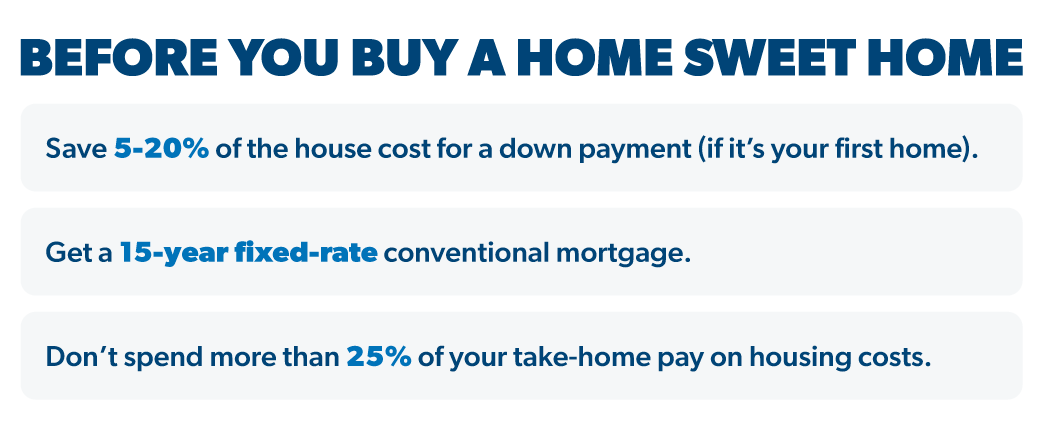
All five of those things together shouldn’t be more than 25% of your take-home pay. When you start spending more than 25% here, you become “house poor,” meaning your house might be awesome, but the rest of your life suffers financially. Who wants to live in a three-story house with no furniture or a have a gourmet kitchen with no money to buy groceries?

Those may seem like extreme examples, but being house poor can put you at extreme risk later on.

As you look at those pieces of the mortgage-payment puzzle, remember these main takeaways:

Before you buy a home sweet home, save 10-20% of the house cost on a down payment. Get a 15-year fixed rate conventional mortgage, and avoid spending more than 25% of your take-home pay on housing costs.

HOA Fees

Some neighborhoods or complexes have homeowners’ associations. Those associations generally have monthly fees. The bad part about HOAs is that some are poorly managed. Ask your real estate agent to do some digging for you so you’ll know what you’re getting into.

The good of HOAs is that this group is in charge of maintaining and improving the shared properties. Maybe your HOA fee covers your use of awesome amenities like a pool, playground, pet spa, landscaped walking trail, or the like.

Someone’s got to take care of those things, and someone’s got to pay for it. Everyone in the neighborhood splits the costs with HOA fees. Make sure you know this cost before you buy.

Utilities

Natural gas, electricity, water, trash collection, internet, and television streaming services: These are some of the most common utilities.

Of course, not all of those are necessities, but have them in mind as you budget. You might already be paying for these as you’re renting, but sometimes your rent includes a couple utilities.

Also remember that if you’re up-sizing, several of those bills will increase. It costs more to heat and cool a three-bedroom, two-bath bungalow than it does a studio apartment, for example.

Lawn Maintenance

If you’re moving somewhere with a lawn, you’ll need a maintenance plan. Are you going to mow or hire a crew? Will your obsession with coral-colored roses be a constant temptation as you wish to spend half your paycheck on a garden the Queen of Hearts herself would envy?

While the roses can wait, you don’t want to make enemies of the neighborhood by growing your grass miles high. Plan on a reasonable amount of money going toward lawn care.

Home Maintenance and Repairs

When you own rather than rent, one of the biggest adjustments is home maintenance and repairs. They become your problem. No more ringing up the landlord when a family of skunks moves under your deck or your HVAC goes kaput on a sweltering summer day.

Those are now on you. You get to call pest control or that local air company who got past copyright issues and named their company Mr. Freeze. And you get to pay the bill.

From gutters to garage doors, roofs to refrigerators, toilets to termites, your housing budget will look different when you make the move to home ownership.

But if you’re ready, don’t be wary. We are a budgeting tool, after all—budgets are our jam. Here are three tips for how you can make your budget home-owning-ready.

How to Budget for Home Ownership

1. Keep an emergency fund for surprises.

If you don’t already have one, you need an emergency fund. Start by saving up $1,000, then pay off all your debt, then build that emergency fund up to enough money to cover three to six months of expenses.

The thing with surprises is you don’t know when they’ll happen. But you do know surprises will happen. That’s what your emergency fund is all about—being cash-ready to meet those surprises.

2. Create sinking funds for semiannual expenses or repairs.

Here’s the thing: Some of those repairs and home maintenance issues mentioned in the previous point really aren’t surprises. When you own a home, you need to regularly inspect appliances and other aspects of your home so you can know what will need some financial attention soon.

For the repairs and replacements you see coming, as well as the semiannual expenses (like a quarterly bill for pest control), you can set up a sinking fund in EveryDollar. Calculate how much money you need by when, divide it by the months until that time, and start stashing cash in the fund in preparation.

3. Have budget lines for the monthly home expenses.

For all the steady, monthly expenses—like your mortgage payment, water bill, electricity, natural gas, and such—you need to set up separate lines in your budget. If you’re doing this for the first time, look back at your bank statements to see the average bill for each, and put that in as the planned amount.

Budgeting for each of these expenses keeps you from spending your light-bill money on laser tag by accident. Once you’ve got housing and utilities covered, budget for food and transportation—then you can spend what’s extra on money goals and fun.

Now you’ve got the knowledge you need to be financially ready to buy a home. Next, you need someone in your corner to help you make the best choices along the way.

But how do you find a trustworthy real estate agent you can count on to keep your best interests at heart? You get a recommended Endorsed Local Providers. They’re experts in the field—the best of the best in your area—and we’ve checked them through and through so you don’t have to.

You can focus on the fence, baby birds, tire swing, shiplap—oh, and that awesome down payment. Your recommended ELP will focus on getting you the best deal on your new home!

How to Save for a Vacation in 6 Easy Steps

Ahhhhh. Vacation. The time to get away from it all, sleep in a different bed, eat food someone else makes, and see new sites.

It’s fun. It’s relaxing. It’s budget-busting. Hold up!  Wait a minute on that last one, because it doesn’t have to be. You don’t have to—and you shouldn’t—overspend or go into debt to enjoy a getaway.

Cash-flow your trip! It just takes planning ahead. We’re here to help by sharing how to save for a vacation in 6 easy steps.

1. Decide when to travel.

We’re going to be really frank here. Frank as in honest. Not as in Sinatra.

If you have debt, it’s not in your best financial interest to take a big vacay. You need to buckle down and drive debt out of your life. Get furious. Get fast. Get debt-free.

So the first “when” you need to consider is “when you’re out of debt.”

Secondly, did you know certain times of year and even days of the week make traveling cheaper? Seriously. Look into off-season rates to your desired locations. Fly on Tuesdays, Wednesdays, or Saturdays for cheaper tickets. Arrange your trip to check in to your hotel on a Sunday (the cheapest day) instead of a Friday (the most expensive). That’s right—staying during the week rather than the weekend is usually cheaper.

How do we know that great stuff? We learned from our friend, the best-selling author and money expert Rachel Cruze. Thanks, Rachel! We love your show, btw.

2. Pick a destination.

It seems there are two types of people: beach goers and mountain lovers. Okay. Really, there are millions of types of people. International adventurers, all-inclusive cruise enthusiasts, treehouse shack seekers, National monument and attraction advocates . . . you get the idea.

We don’t claim to know where you want to go—but just remember some of those previously mentioned tips: consider off-season, fly and stay on cheaper days of the week, etc.

And don’t assume a travel agent is an expensive idea. Some of them charge you no fee whatsoever for their services because they’re paid by their associated vendors. Aka, they’ve got connections and knowledge—something incredibly valuable if you’re going overseas.

3. Determine the cost of the trip.

Once you know the when and the where, start breaking down the how much. Let’s say we’re going on a trip to Washington D.C. This is a super-smart destination because the place is packed with free attractions. It’s like our country ‘tis of thee wants to us know more about our history. Win-win.

So while we do our budget breakdown, we figure in lodging, food, transportation, and flight. Looking into good deals, we see a train pass for our stay is just around $10 a person. And we know we’ll walk around a lot too. Bravo, us. Here’s to being healthy and saving money.

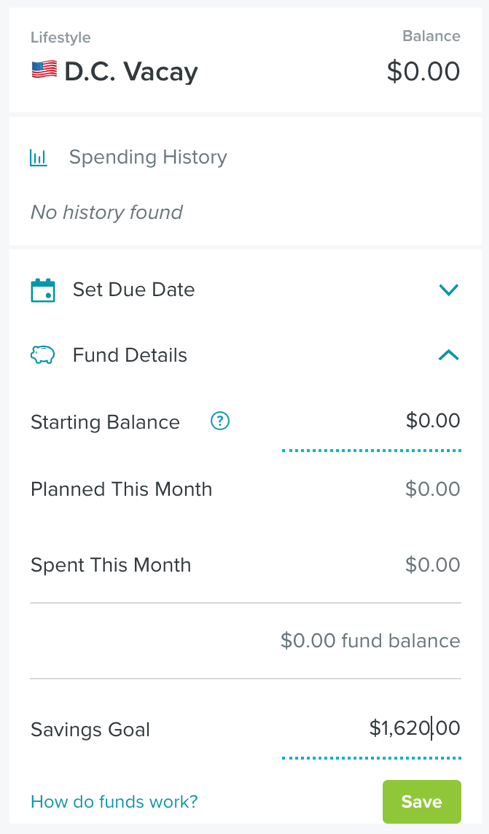
Total expenses look like they’ll be around $1,570 for a couple, and we add in $50 just in case. We’re going to need $1,620 to make this trip happen.

Do the same kind of math with your own trip to find out the grand total. Too much too soon? If you push your trip to a further date, you’ll have more time to save. Also consider shopping around for more deals or tweaking a couple of your plans. Aim for a doable date and reasonable costs.

4. Start budgeting for your vacation.

It’s time to get down to business. The business of budgeting. This is the literal saving-for-your-vacation step. And it’s way easier if you set up a fund in your EveryDollar budgeting app.

Tactically speaking, this is how you do it:

  • First, pick a budget category. We decided on “Lifestyle.”
  • Then click “Add Item” and label your fund—we called ours “D.C. Vacay.” And we even added in a patriotic American flag emoji.
  • You’ll see a piggy bank pop up next to the words “Make this a fund.” Click this and the next button with the same words.
  • Scroll down and put the total you need for this big expense as the “Savings Goal.” That’s the screen shot you see below.
budget screenshot

5. Work to make your vacation savings fund grow.

You’ve got a plan. So let’s make it happen! Grow that fund bigger and stronger than Bruce Banner when he gets angry. But, unlike the Hulk, you’re totally in control of your green.

How many months do you have until your trip? Divide the total amount you need by the months until you travel. This is how much you should budget to save each month.

Again, tactically speaking, as you add money to your fund throughout the month, type it into the “Planned” section. Every time you add money to the “Planned” section of your Sinking Fund, it immediately adds that amount to your fund. As you watch the fund grow, the trip becomes more and more real.

And where does that extra money come from? You can tighten spending in other budget categories, sell some stuff, pick up a side hustle, or take on overtime for a few months to make a higher income.

What you don’t do—at all ever—is put any of this on a credit card. And don’t be tempted to take out a credit card for “points” or “miles.” In the end, it’s not worth it. You don’t want to still be paying off the trip months after it’s over.

When you save cash and pay cash for your vacations, you bring home memories—not debt.

6. Track your spending on the trip.

This last one is what we call a pro tip. You see, budgets aren’t just numbers you put down on paper and never think about again. If you want your money plans to happen—you’ve got to interact with your budget. 

In this case, we mean that you need to be tracking all the spending that happens for and during your vacation.

Let’s get tactical one more time. Before you head out for all the fun—set up budget lines for each of the main categories of your trip.

You’ll see in our screenshot what we made one for lodging, food, transportation while there, and flights to get there. You may need a line for attractions and entertainment. Remember, in our example we’re about to live it up with all those free museums and memorials in our nation’s capitol. That’s why we don’t have a line for the stuff we’ll be doing. 

track your spending while on your trip

Go set up a budget and a fund so that you can soon enjoy all the relaxation of your vacation!

How to Pay Off Debt Faster Than Ever

Almost three out of four Americans say they’re burdened with debt.1 Whether or not you’re part of the majority here, it’s clear debt is quite common. But it doesn’t have to be this way. Besides, who wants to be common? Who wants to feel burdened?

That’s what debt does. It holds you back from excellence, from achieving your dreams, and from feeling peace.

But again: It doesn’t have to be this way. (Yes, we said it twice so it hits home.)

Not only do you not have to feel burdened by your bills, you also don’t have to spend your life owing money. You can pay off your debt. You can be the one in control of your money—not the lenders you’re borrowing from at a price that’s holding you back.

With these six tips, you can get rid of debt faster than ever. So here we go.

1. Start viewing debt differently.

You may think paying off debt is a numbers game. That makes sense at first: Debt is about money, and money is about numbers. But what you’re really dealing with here is the ultimate mind game—one we completely believe you can win. But first, you have to rethink your debt situation.

To most people, debt feels inevitable. Everyone has a car loanYou can’t get a degree without debtCredit cards are necessary to manage money. You’ve most likely heard these things. Maybe you’ve said these things. But these things are not true!

The truth is this: You can pay cash for a car, graduate with zero student loans, and get by in life just fine (splendidly, in fact) without credit cards. 

If you really want to pay off debt for good (and you do!), it’s time to start viewing debt differently. Decide today that you won’t take on any new debt and that you have what it takes to pay off your old debt. 

2. Make a budget.

But where will you find the money to pay off all that debt? It’s time to get real with your money. It’s time to budget.

If you don’t have a budget, now’s the perfect moment to start one. If you already budget regularly, that’s awesome! In either case, keep reading. We’ve got more to share.

Budgets can seem intimidating to new budgeters. And even the pros sometimes have trouble keeping track of every dollar they spend, which is a necessity for a debt-free life.

3. Save a $1,000 safety net against debt.

You’re determined to leave debt behind for good. You’ve got a budget. Woo-hoo! The next step is vital. You need to save up $1,000. We call this a starter emergency fund—or Baby Step 1 of our 7-step plan for your ultimate financial wellness.

What this money does isn’t magic. It’s logic. But it’s bound to feel magical. When you have this safety net for life’s curveballs (because you know they’ll come), it means you don’t have to turn back to debt. You have cash ready to go. That’s the logic.

The magic is the feeling you get when you pay cash. You have the money you need for emergencies. You don’t have to rely on someone else or something else to cover them.

We’ve got plenty of ideas on how to get that $1,000 quickly—and an interactive, plump piggy bank for you to log your savings progress.

Having $1,000 in your savings account will probably make you feel like dancing. So do it. Dance. Then get back to these tips.

4. Write down all your debt.

Some people want to ignore this step more than anything. But listen: Ignoring your debt doesn’t make it go away.

Don’t feel bad if this step scares you. But don’t let that fear keep you from moving forward. It’s time to look every last dollar of debt in the eye and get real with it.

You do that by writing down every single debt you have. Name the debt. Write down the total owed. Write down the minimum monthly payment. Then move to tip five.

5. Create a debt payoff plan.

You’ve identified all your debt, so it’s time to plan your attack.

First, get back into your budget. Tighten your spending, cut extras, and free up money so you can get debt out of your life forever.

Second, it’s time to use an awesome tool called the Debt Snowball.

Forget about the size of those interest rates for right now. Mathematically, you may think you should go for the highest interest rates first. But this isn’t about mathematical formulas. This is about motivation.

The debt snowball is successful because it builds on small wins. When you pay off the smallest debt first, you see progress right away and stay motivated until you’ve paid off every single debt.

Be intense about tracking and tightening your spending. Be like an ostrich. Some underestimate this awkward, flightless bird, but its kick has power and strength enough to take down the king of the jungle himself. Never stop kicking until that debt lion is out of your life forever, ostrich friends.

6. Celebrate every win along the way.

Like we said, beating debt is a mind game—and, to be honest, a heart game too. You need your brain and your heart on board. And along the path, you need to praise both with a little hoopla.

Now, “hoopla” doesn’t mean you book a luxury bungalow on a private island to reward yourself for paying off that $150 personal loan to your Uncle Scott. But your favorite scented candle, a fancy coffee drink (don’t hold the foam, barista—double it!), or a pizza night with the family—those are great ways to celebrate any win within Baby Step 2. It’s a reminder to yourself (and everyone who’s in the debt payoff game with you) that the lion won’t win. You will, you beautiful ostrich.

12 Things Dad Taught Us About Money

Want to hear a money-related dad joke? (The answer is always yes.)

Anyone who thinks talk is cheap must not be paying his teen’s phone bill.

Want another? (Of course.)

You’re spending so much money on coffee each month, it looks like your budget got mugged.

Mugged. Get it? Oh man.

But seriously, dads give us a ton of punny jokes and grilling tips, but they also pass down loads of wisdom. In honor of Father’s Day, we want to look into some of the dadisms many of us grew up hearing and see how they relate to budgeting. Here are 12 things Dad taught us about money. 

1. “Money doesn’t grow on trees.”

Well, we could get technical and talk about how paper is made from trees, but we won’t go there. We will go where Dad was sending us: You can’t just walk outside and pluck bucks from tree limbs. Use your limbs and get to work.

2. “Sleep on any big purchase.”

You know what being impulsive does? For Romeo and Juliet, it led to their early demise. Don’t be like Romeo and Juliet. Don’t rush into big purchases. Let the first impulse simmer down by taking at least one night to think before you buy.

3. “Leave room in your budget to help others.”

Marie Kondo has created quite the catchphrase: Does it spark joy? Well, this dad tip proves he knew about sparking joy in a different way before Kondo came on the scene. Research shows giving to others boosts your own happiness.1 Help others. Help yourself. That’s a win-win from Dad. 

4. “Be thrifty, not a scrooge.”

It’s smart to put time, thought and effort into saving money. But hoarding treasure like Smaug in The Hobbit or Mr. Krabs in Spongebob Squarepants is just too far. Don’t let your thrifty ways keep you from sparking that just-mentioned joy in giving. And don’t let it keep you from enjoying and feeling secure in the life you have now.

5. “Always live below your means.”

When you spend less than you make, you can use that extra money to make your money goals happen—like saving up for emergencies, crushing debt, investing for retirement, paying off your house early, etc. These things aren’t doable when you’re sending all the money that’s coming in right back out again! Live below your means.

6. “Don’t take money advice from broke people.”

It makes such good sense. However, if someone was broke and made a proven plan to get out of that situation, that’s different. That’s Dave Ramsey. We love him. We’ll take his advice all day long.

In fact, the advice means more because he knows what it feels like to hit rock bottom and climb back up again. That’s who you take advice from. The climbers. The achievers. Not the broke.

7. “Hard work is hard work.”

Okay. Read it again. It’s not a typo or accidental repetition. It’s truth. But there’s payoff. So work hard, and don’t expect great things to come easily.

8. “Waste not, want not.”

Maybe our dads came up with this one by watching their moms rinse out gallon food storage bags and reuse them. Or maybe by seeing their dads fix the busted toaster instead of chucking it in the trash. Whatever taught our dads this phrase, it’s one we could all stand to put in play far more often. Waste less stuff—and save more money. 

9. “Save for a rainy day.”

Why? Because it rains. We cannot predict what emergencies will come, but we can predict they will come. So, we’re financially ready for them with emergency funds. Hey, rain—I can pay cash for a light sprinkle or a downpour. I’m ready!

10. “Learn the power of the word no.”

Because it’s a powerful word. With money, we need to know how to say no to ourselves and to our immediate wants. Because delaying gratification for now will bring an incredible payoff later.

11. “If you don’t need it, it’s not a good deal.”

Yes, Dad. We shouldn’t buy a second air fryer—even if it’s on sale. Even if it’s a “steal of a deal.” Because all it’s stealing is . . . our money. If we don’t need it, spending money on it isn’t actually saving money. It’s wasting it.

12. “Beware financial opportunities that seem too good to be true.”

“Because they probably are,” Dad warned us. Get-rich schemes are just that—schemes. Getting rich takes time.

This reminds us of another dadism: Anything worth doing is worth doing right. It’s worth the time and effort to budget, get out of debt, save up money, and build wealth.

Hey, Dad. Thanks. Thanks for playing catch, or driving us to all those flugelhorn lessons, or teaching us the Pythagorean theorem so we could pass geometry. And thanks for taking the time to give us those words of wisdom that we can now use to make wise money choices on our own.

The Basics of Financial Planning

Do you wonder what you should do to get your financial planning ducks in a row?

If you answered yes, then you’re going to love all the info on the basics of financial planning this article brings. From budgets to estate plans. From insurance to proven money management plans. We have it all. And, once you read on, you will too.

Get on a budget.

You can build incredible things with your money, but you can’t go anywhere if you don’t first have a budget. It’s like all the awesome pallet projects you see online. You can make a headboard, a bike rack, a compost bin, or a workbench on which to make even more pallet creations. But you can’t make any of those upcycled dreams come true if you don’t first have a pallet.

The same is true with your money goals and financial dreams. You can build incredible things with your money, but you can’t go anywhere if you don’t first have a budget. So before you take any other step in your financial planning, you need a budget.

Put an estate plan in place.

After your budget’s in place, it’s time to do some very adult, responsible, not really fun—but really important—things. To make it more enjoyable, we’ll pretend it’s an adventure-filled train tour. First stop: estate planning.

Wills

Nobody wants to talk about it, but we’re going to talk about it. Because that’s just how important it is. You need a will to protect your family after you, er . . . you know, pass. Though some avoid making wills because of time, confusion, cost or how much of a downer it is, don’t let anything stop you from this important financial responsibility!

Power of Attorney

This is where you lay out your end-of-life wishes and name the person who is allowed to make medical and financial decisions for you if you’re no longer able to. Again—not a super fun topic. But we have super good news.

You can get your will and power of attorney knocked out in one 20-minute-or-less online experience with our recommended company: Mama Bear. The name alone is reason to use them, but they’re also easy and legit in the legal form world. Protection, confidence and peace of mind in one packaged deal? Yes, please.

Set up all your insurance needs.

Next on our financial planning tour is Insurance Land. No, that’s not an amusement park with costumed characters—it’s way more important.

Health Insurance

You need this. Research shows medical issues were the cause of 66.5% of bankruptcies.1That’s because a major medical emergency can cost hundreds of thousands of dollars. Most of us don’t have that lying around—so get health insurance.

If you and your family are pretty healthy, look into a high deductible health plan with a Health Savings Account (HSA). Higher deductibles mean lower premiums, and putting money into your HSA to pay for medical expenses can save you money at tax time.  

Term Life Insurance

Here are the basic details: You need a 20- to 30-year term life insurance policy for 10–12 times your income.

Why term over whole life insurance? Many, many, many reasons. For one, with whole life insurance, you pay that premium for . . . well, your whole life. So even after you’re retired and living comfortably on all your investments, you’re still paying for a life insurance plan you don’t even need anymore. No, thank you.

Another reason we’re team term life is because you’ll save around $300 a month (that’s $3,600 or more a year) with term life instead of whole life. That’s a whole lot of money and a whole lot of reasons to say no to whole life insurance.

Auto Insurance 

Driving without auto insurance is against the law. So there’s one incredible reason to make sure you have this coverage. Again, if you have a fully funded emergency fund, high deductibles are your BFF. And make sure you carry plenty of liability coverage—at least $500,000 worth of it.

Here’s your bonus tip: Most of us set up a policy and keep it until we get a different car. But your car insurance policy could be outdated or—way worse—you might be overpaying! No one wants that. Check in on your policy!

Home Insurance

Home is where the heart is. Home is where your stuff is. If you’re a homeowner, your financial planning isn’t complete without home insurance coverage. We recommend a policy that at least helps you rebuild your home (extended dwelling coverage), replace your stuff (personal property), and cover injuries and damages to your home (liability). And depending on your location, you should look into natural disaster coverages that aren’t in your regular policy.

Renters, you aren’t off the hook. You need renters’ insurance! You’ve still got stuff, and your landlord isn’t required to pay you anything to replace it if there’s a fire, flood, burglary or any other disaster.  

Long-Term Care 

Not everyone needs this coverage (yet), but once you turn 60, long-term care is essential. This insurance covers important long-term costs (hence the name) not covered by Medicare. Being covered by long-term care insurance protects your retirement savings from costly health expenses and saves you from a ton of financial stress. Keep this one on your radar for the future.

Long-Term Disability Insurance

It’s easy to say, “It won’t happen to me.” But that’s playing with odds you can’t afford. One-fourth of today’s 20-year-olds will experience a disability by age 67.2If you end up being one of the four, long-term disability insurance will replace your lost income due to a permanent disability.

Identity Theft Protection

It’s 2019, friends. ID theft is real. Unless you’re living a hermit life 100% off the grid in a literal cave, you need this protection. In 2018, the FTC’s Bureau of Consumer Protection announced consumer complaints hitting 1.1 million fraud reports and $905 million lost.3That’s not just an expensive inconvenience. It’s a true threat. Protect your money. Protect your identity. Get ID theft protection.

Umbrella Policy

If you have a net worth of $500,000 or more, first of all—bravo! Second of all, you should look into a personal liability umbrella policy for an extra layer of protection. Think of it as using an SPF of 30 instead of the minimum recommendation of 15. Don’t get burned. Get covered with an umbrella policy.

So. That was a lot. If you don’t know where to start as you’re making sure you’ve got all your insurance needs covered, we’ve got you covered with our 5-Minute Coverage Checkup. It’s free. It’s quick. And it gives you clear steps to take in this vital part of your financial planning.

Get on a proven plan to meet your money goals.

The last stop for your financial planning train is to get on the proven plan to make all your money goals come true. Goals are actionable dreams. They don’t just happen with wishes or good intentions.

So take action, one Baby Step at a time. (That’s why they’re called the Baby Steps, though we’re tempted to nickname them Genius Steps because they sure make you look and feel like one.)

And as you accomplish each step, you’ll become closer and closer to the end financial goal of living a secure, glorious retirement where you can live well and help others. But it starts on Baby Step 1:

1. Create a starter emergency fund.

Life happens. Be ready with $1,000 in the bank as a starter emergency fund. This way, you’ll meet life with cash instead of crisis.

2. Pay off all debt using the debt snowball.

Debt’s good for one thing: holding you back. No thank you, debt—we’re moving forward.

So the second step of our proven plan is to pay off all debt, starting with the one with the smallest balance. Why start there? Just like the old arcade boxing games, it’s easier to knock out the smallest opponent first. Then, when you’ve got your confidence up and your momentum going, the rest will be easier to take down blow by blow by blow.

3. Build a fully funded emergency fund.

Debt’s gone. So long, debt, not nice to know you. Now it’s time to keep yourself safe from the temptation of running back to debt for any future emergency. That means building up a fully funded emergency fund of three to six months of expenses.

Put it someplace easy to access in an emergency, like a money market account. And then enjoy the security of knowing that, though rainy days will come, you’ve saved up for them.

4. Invest 15% of your income for retirement.

Once your emergency fund is full-up, begin putting 15% of your gross income into retirement accounts. First look into your employer’s 401(k). Max out their match, if one is offered. Then open up a Roth IRA for the rest.

Once you’ve got that 15% going in, you’ll start working on the next two steps as you continue to invest. That’s right, Baby Step 4, 5 and 6 are a powerful trio, working together, at the same time, on a vendetta to make your money live its best life for your future.

5. Save for your kid’s college fund.

If you’ve got kids at home, start stashing cash away for their college education. Do not even consider school loans. They are the sneakiest of debts: promising to make young people’s dreams come true then holding them back from making any of that happen after graduation because the loan repayment costs are so suffocatingly high.

So as you’re saving up for their college funds, also give your kids great financial guidance. This includes selecting an affordable school and constantly applying for all of the grants and scholarships possible, like a forward-thinking squirrel gathering acorns for the winter.

The gift of cash and knowledge of how to get their degree debt-free are two of the best financial foundations you can create for your children.

6. Pay off your home mortgage early.

Imagine an extra $1,515 in your budget every month. That’s the average mortgage in America.4So with this Baby Step, you’re paying off more on your home payment so you can move away from having a mortgage later on.

7. Live and give like no one else.

Once you’re mortgage-free, empty-nesting, and ready to retire, you’re in the step of reward and forward. You get to reward yourself by taking it easy—or taking all those trips around the world you always dreamed of. And you get pay it forward by helping others in a way you never could when you were in the middle of your own debt-free journey. What a beautiful place to be.

So there you go. Start working your way through those four main areas to ride this financial planning train into the sunset of Responsibleville with the ultimate destination of Retirementown. Whether that, for you, is an ongoing RV tour of American attractions or a retirement home on the lake, you’ve got this.

It just takes knowing what steps to take, then taking them. And knowing the best people to get on your team who will help you along the path—trusted financial planning and insurance pros! Connect with one to move forward in confidence.

Start it all now. Do it for your future. Do it for you.

How to Get the Raise You Want

Getting a root canal, going on a blind date, and asking for a raise. What do these three things have in common? They make the majority of us super uncomfortable. While this article isn’t going anywhere near those first two things, that last one—we can help you there!

We know you work hard for your money. And some days it feels like there’s not enough of it to go around. You think to yourself, If only I had a raise, I could save more money, pay off debt, start investing in my retirement, and (insert other money goal here). We get it.

So here’s info on how to get the raise you want, both by finding more money you already have and moving up at work.

How to Give Yourself a Raise

Not to be harsh, but before you start asking for more money at work, you should work at managing the money you already have. This isn’t a cop-out answer on how to get a raise. It’s an “It begins with you” answer. Because that’s the truth. Michael Jackson knew: You start with the person in the mirror.

When you stick a mirror in front of the way you treat your money, you’ll probably be surprised by how a few tweaks in your actions will free up money—making it feel like you just gave yourself a raise. (As MJ would say, “Come on. Make that change! HeHe!”)

1. Create a budget.

This may sound crazy, but budgeting can help you find money you didn’t even know you had. It happens all the time. That’s because a budget shows you where you’re spending money.

You’ll finally see that extra $200 you were literally eating away with all those random snacks. Or you’ll realize the $900 you spend on groceries every month could be $700 if you start being a little more intentional with meal planning and grocery-list-making .

When you budget, you tell your money what to do. You tell your $200 snack habit to shrink to a more reasonable $20. You put your grocery spending on a diet. You start spending less because you’re watching your spending.

You just rounded up more cash for your money goals. Welcome to Raisetown, USA. Population: You.

2. Quit paying for stuff you don’t use.

Be honest. How many video streaming services do you have? How many do you need? Cancel what you aren’t using right now. Get a library card. That free entertainment frees up money in your budget.

Then look in other areas of your life. Remember January 1? You signed up for a gym membership, a weekly personal trainer, and a kale-delivery group. You soon realized you prefer yoga at home and hate kale. It happens. But are you still paying the gym, trainer and kale guy? Don’t quit the health. Do quit allthe services you just aren’t using any more.

3. Pay off your debt.

The best way to get ahead? Stop getting behind. Now apply that to your money. Using credit cards gets you behind in your finances. All it grows is your debt and your pile of stuff (that isn’t even really yours). Credit card companies lure you in with a low interest rate then bump it up. And you may have the best intentions to pay it off each month, but miss one payment, and that interest skyrockets to 30%!1

Grab your scissors—cut up your credit cards. Then start paying off all your debt. Keep more of your own money.

4. Review your insurance policies.

Checking up on your insurance to make sure your coverage is right is probably not at the top of your “Fun Things to Do”list. But it should be at the top of your priority list. Why? You need to make sure you have the right coverage and the best rates.

If you’ve had big life changes, you may need different coverage. Even if you haven’t, there could be a better deal out there. What if you’re overpaying? No, thank you.

For example, if you have whole life insurance, the better deal is term life. You pay on whole life for your whole life (hence the title). It’s a total rip-off, pretending to have a great savings plan that actually has a horrible rate of return. You could go from just $125,000 of coverage in whole life to $400,000 in term life and save $82 a month.2

Hey, if your boss offered you better benefits plus a $82 a month raise, you’d jump on it. Give yourself that bonus by switching to term life insurance.

How to Get a Raise at Work

Now let’s get into the nitty gritty of how to get a raise in the workplace. We got these steps from our friend, the career expert and author Ken Coleman. Thanks, Ken!

1. Do a self-assessment.

This isn’t just a good practice to prep for your annual review or before talking to your leader about moving up in the company. You should do some level of self-assessment every month or so. Ask yourself a few important questions:

  • Am I meeting the expectations in current role?
  • In what ways am I going above and beyond in my current role?
  • In what ways am I missing the expectations of my current role?
  • If I were my boss, what would I expect to see happening in my role before giving a raise?

2. Get feedback from leaders and peers.

Ask others around you how to improve. Most of us don’t love getting feedback because it can feel like personal criticism, but this info will let us see if our own self-assessment is spot on. Plus, it helps us move forward to the next step.

Try questions from this list. The mix here should give you direction without feeling attacked.

  • What are some books you’d suggest I read to grow in my role?
  • What do you think is best way for me to step it up at work?
  • Can you think of a time when you grew a lot in your own career? What advice do you have for me from that experience?
  • What’s something actionable I could do this month to improve?
  • How can I work with you better in the future?

3. Work with your boss to create goals for growth.

Use what you learn from assessments and feedback to make a real game plan for growth. Create goals that are SMART: specific, measurable, achievable, relevant and time-sensitive.

In the best work environments, you have regular meetings with your leader. If this isn’t something on the schedule for you, ask if you can meet to talk through and make goals based on where you are and where you want to be.

Without this step, you’ll move about as quickly as a sloth at naptime. Don’t be a sloth. Wake up your dreams with actionable goals.

4. Be patient and work the plan.

Most people don’t work up from the mail room to the corner office in one day. And that’s not even what you’re trying to do. But you still have to have patience when you want a raise or a promotion. You have a plan in place and goals to get there. Now work those goals. And get there!

During this time, put yourself around people doing what you want to be doing more of, and watch how they act and react. Ask them questions. This is called the Proximity Principle, and it’s explained to the max in Ken Coleman’s latest book. If you’re wanting a new job or to advance at your current one, this is the read you need.

Dreams don’t come true overnight. They’re about determination. They’re about movement. They’re about grit. Apply those things to your budgeting, money management, and work ethic—and you can move on up at work and in life.

How to Save Money: 20 Simple Tips

You work hard for your money; it should work hard for you. And while intentionality is quite the hot word these days, it’s really the key to making your dollars put forth that extra effort. Being intentional is how to save more money (and spend less!) each month.

Because you know the money isn’t really the muscle, right? You are. Your money isn’t achieving new and wonderful things. You are!

Still, there’s a whole wide world of ways to save money out there. Where do you even start? Start quick. Start easy. Start here. We’ve got 20 simple tips to help you save money throughout your day, week, month, year, life! And here they are.

20 Easy Ways to Save Money

1. Download money-saving apps.

You can save money from anywhere your thumbs are. Just tap-tap-tap your way to coupons or cash back by downloading awesome apps like Ibotta, Checkout 51 or RetailMeNot. Let Honey and GasBuddy tell you about the best prices available on items in your wish lists or gasoline for your car. And don’t forget to download the apps for your favorite stores. You can check out sales, join rewards programs, and nab coupons. Just be careful about the temptation to online shop when Target, Walmart or Amazon are there every time you open your phone.

2. Check in on your subscriptions.

Do you really need multiple television and music streaming services? How many subscription boxes or magazines show up in your mail each month? We aren’t out to bash these services. But if you haven’t thought about it in a while, you may be signed up for stuff you don’t even really use, watch or read any more. If you’re trying to save some extra cash, cutting out that narwhal collectible of the month club or subscription to pretzel enthusiast magazine could be just the thing.

3. Go green(er).

Green is our favorite color. Have you noticed? But in this case, we’re talking about making more energy-efficient life choices. Some of these are, quite honestly, initial investments. But they all pay off in the end.

For savings on home expenses, we’re talking about turning off the lights when you leave a room, buying light bulbs that have earned the ENERGY STAR, purchasing a programmable thermostat, or taking quicker showers. To save on transportationcosts, carpool, use public transportation, or start biking.

All of these green changes can add green to your wallet. Like dollar bills. Which are green. Hence our favorite color.

4. Buy used.

You’ll need to use your discretion on this. Don’t buy used tires, toothbrushes or tacos. But if you’re in the market for a car, pet (shelter furbabies for the win!), tools, baby clothes, video games, or books, then you can save money and inherit instant character by purchasing gently used items instead of new.

5. Plan creative dates.

Myth: Spending a lot of money on dates will mean securing the love of your life. Truth: You can have fun and fall in love while still being thrifty. Fill a picnic basket with popcorn, apples, an assortment of cheeses, and chocolate (of course), then take it on an enjoyable hike. Bring home Chinese takeout and dine directly out of the boxes while streaming your favorite show. Browse the aisles of a used bookstore before grabbing coffee and dessert. Enjoy the companionship more than the cost.

6. Evaluate your TV choices.

If you’re paying high prices for your cable package and watching very few of the channels, you aren’t alone. Plenty of people are realizing they can save money and still get all the shows they want (and more!) by switching to other choices.

Look into YouTube, Vimeo, Hulu, Netflix, or Amazon Prime Video. Try watching recently aired episodes online. Or use that library card! You don’t have to jump back to medieval days where your only entertainment was watching the knights joust. Just trade that cable bill for a lower-priced—but still awesome—option.

7. Work out online.

Some of us need the interaction of others that happens in a gym. Others of us just want to get fit without the membership, personal trainer, and special class fees. If you’re wanting to burn calories without burning through your paycheck, check out exercise-streaming services and even free YouTube videos. Plenty of fitness gurus have realized we need stay-at-home, non-DVD options, and they’re putting out high-quality content that we can get swol to any time of day from the comfort of our own living rooms!

8. Ditch your credit cards.

The best way to get ahead? Stop getting behind. Sounds logical, right? So apply that to your money.

Using credit cards gets you behind in your finances as it grows nothing but your debt and the amount of stuff you have (that isn’t even really yours). Debt gives the false illusion of ownership. It’s a constant floating cloud of obligation that hangs over your head, keeping out the warm sunshine of true ownership, which comes from credit card-less debt-freeness.

Ditch the credit cards, and you can start owning for real. You can shift those debt payments toward your money goals. Not only is it an empowering life change, it’s also going to end up saving you so much money in the end.

9. Wait before you buy.

Maybe your parents told you to sleep on it before making a big decision. Some people recommend giving a choice a couple days’ thought. Following this “wisdom to those who wait” philosophy, spend time price-checking, pro-and-con weighing, and desire measuring before you buy.

Desire measuring? Sure you want that new multi-pocketed, all-weather, flannel-lined-interior laptop case the moment you first lay eyes on it. But does that desire diminish over time? Impulse buying is expensive. Practice a little patience before substantial purchases. You’ll save money by finding a lower price during that research time or deciding not to buy after all.

10. Enjoy the great outdoors.

There’s a whole world out there, and it’s just waiting to be explored. On the cheap. Of course, there are plenty of ways to enjoy nature while paying a pretty penny, but there are also a plethora of penny-pinching pleasures awaiting you in the wild blue yonder. Hiking. Biking. Spiking (a volleyball). Kayaking. Backpacking. Flapjacking (on your campfire stove). Corn-mazing. Stargazing. Curtain-raising (with outdoor theater). Get out and save up.

11. Brew your own coffee.

If you’re spending around $4 a day on your favorite barista blend, that’s $28 a week and around $120 a month. Instead, you could spend around $20 a month brewing your own and put that $100 into savings, your dream vacation sinking fundretirement, or whatever money goal you’re wanting to knock out. (Jab. Cross. Punch. Caffeinate.)

12. Sell stuff.

Clutter can give us a false sense of fullness. When, really, clutter’s just a sign of stuffness, which is a new word we made up to describe when you’ve got stuff just to have stuff. It brings no good and overwhelms every closet, drawer and corner in your house.

You can cash in on the clutter in your life by selling your stuff! Post things online, take things to a consignment shop, or have an old-fashioned garage sale! Lower your stuffness as you create calmer surroundings and make some extra cash.

13. Search for free entertainment.

Free entertainment is bad when it’s tickets to a subpar comedian performing at a shady club in the bad part of town. Free entertainment is great when it’s books, audiobooks, e-books, movies, story times, and presentations or performances from talented artists. Where can you get hooked up with that kind of loveliness? At your local library. Get your library card. Right now.

Then start looking for more no-cost amusements. Are there free museums nearby? What parks and playgrounds are in your area? Do they host movies, festivals or events? Are you close to a farmer’s market? Does your local symphony offer any free concerts? What community events do the local churches offer around the holidays? Keep your ears and eyes out. Keep money in your pocket and party away.

14. Remove your debit card info from websites.

One of the quickest ways to spend money these days is that “one click” feature or by having your debit card information stored on your favorite sites. When purchasing takes moments and little thought, it’s too easy to overspend.

Instead, take the time to find your wallet, get out your debit card, and enter all those numbers. While you’re doing that, think about whether you really want that half-price vegan red leather moto jacket (when you already have a black one). Imagine yourself dragging and dropping that transaction to your personal spending line when it streams automatically into your EveryDollar Plus account.

If you have the money and the desire after those extra minutes, then go ahead and buy it. If you realize it isn’t worth getting off the couch in the middle of watching your favorite comic-book-inspired television series, then don’t buy it. Senseless spending averted by laziness? Nope. By intentionality. Oh, yeah.

15. Drink more water.

Not only is this tip good for your wallet, but it’s also good for your body, brain and emotions too! It turns out, even mild levels of dehydration can affect our thinking and our moods.(1So ordering water when you’re eating out and using your refillable water bottle will save you the cost of sodas and keep you hydrated and ready to conquer the day.

16. Restaurant smarter.

You can save money by eating out less or by restaurant-ing smarter. When you do go out, take advantage of happy hour specials. They aren’t just for drinks anymore. Let that half-price appetizer fill up most of your stomach so you can buy a smaller entrée. Or eat apps only! Sign up for emails for your favorite restaurants, and you’ll get coupons and promos so you can eat on the cheap(er). (While you’re at it, unsubscribe from any restaurant or store emails that tempt you to get spend-y.) And don’t forget about those surveys at the bottom of your receipt. You can earn discounts or free food in exchange for a couple minutes of your time. When you’re crunching that complimentary chips and queso, you’ll know it was worth it.

17. Buy generic.

You don’t need brand-name everything. You can snob it up on a few items. That’s your right as a discerning shopper. But look into generic medications, trash bags, basic pantry items, cleaning supplies, and more. This is a quick and incredibly simple way to save money every time you shop!

18. Make shopping lists.

Just like you need a plan for your money overall (by making a budget), you also need a plan for your shopping (by making a shopping list). Start by meal planning—decide what you’ll be eat for breakfast, lunch and dinner throughout the week, and then make a list of all the things you need to make those meals happen.

Stick to the list! It keeps you from forgetting things and from overspending each month on your grocery budget line.

19. Hit up those BOGOs and weekly ads.

Stores with BOGO offers are begging you to save money. Pleading. Okay, not that far. But they are setting out the offers you need to sweep in and grab up. How about following this money-saving move: Make those meal plans based on your grocery store’s sales. You can even stock up the pantry and freezer for the future. Just don’t forget what you’ve bought when you’re making meal plans weeks later. Wasting isn’t saving.

20. Budget.

Don’t forget the single most important money-saving method out there—budgeting. Duh! You’ll never make those money goals without a budget.

Retirement Savings: How to Boost Your Investments

Retirement can seem like tomorrow’s problem. But that kind of thinking will leave you working hard for your money—for the rest of your life. Properly saving for retirement now gets you on the path to golden years of glory.

You can boost your investments and make retirement savings the priority it deserves to be. Just follow these nine tips.

1. Start investing today.

By “today,” we mean once you’ve reached Baby Step 4. That means you’ve successfully walked through the first three steps and are now ready to begin saving for retirement.

  • Baby Step 1: Save $1,000 for your Starter Emergency Fund
  • Baby Step 2: Pay Off All Debt (Except the House) Using the Debt Snowball
  • Baby Step 3: Save 3–6 Months of Expenses in a Fully Funded Emergency Fund
  • Baby Step 4: Invest 15% of Your Household Income in Retirement

Notice those first three Baby Steps are all about avoiding and paying off debt. They propel you to a debt-free lifestyle so you can start thinking about the future while living in the security of the present.

The first $1,000 emergency fund keeps you going while you crush your debt. And that full fund you save up on Baby Step 3 means you always have cash ready—so you don’t even think about running back to your borrowing ways. At that point, you’re in the right place to start investing by putting 15% of your household income into retirement savings.

Let’s dive into those details. 

2. Learn your R:IQ.

When you think about retirement, you’ve probably set a specific age as the target. I want to retire when I’m (fill in the number). But in the words of our good friend Chris Hogan, a bestselling author, Ramsey personality, and financial expert: “Retirement isn’t an age. It’s a financial number.”

That financial number should be your target—your retirement savings goal that will get you living the retirement of your dreams.

So, how much money will make that happen? You need to find out your R:IQ or Retire Inspired Quotient. It’s easy. Chris Hogan’s crew crafted a retirement calculator that will show you exactly how much money to invest each month based on your age, income and retirement lifestyle goals.

3. Take advantage of your employer’s 401(k) and company match.

Here’s the simple breakdown of where your investing should start. First, look into your employer’s 401(k). If you have this and you’re able to, max out the amount of contributions you can put into this fund, which is $18,500 a year of your own money.

That $18,500 doesn’t include your company match. If your employer offers thisthen use it with a grateful heart. A company match of any percentage is a great employee benefit to get you even closer to your retirement goals. Remember though, that match isn’t part of the 15% you’re investing. It’s just a lovely little bonus.

After you hit the $18,500 mark, you’ll call in reinforcements such as the Roth IRA, which allows up to $5,500 a year. If you need help working through all this, or you’re ready to invest beyond those two levels, you should talk to an investing pro.

4. Automate your investments.

Have all your investments automate right out of your check—so you never even see them. This tip helps you from being tempted by the immediate desires that money says it can fulfill.

If you’re always moving your retirement investments over manually, you might hear the gratification portion of your brain whisper that this cash would be better used on furnishing a home theater or going on an exotic getaway “just because.”

We aren’t saying you can’t save up for nice things in life. We are saying you shouldn’t shortchange your retirement savings to get those nice things. An auto-draft can remove that temptation altogether.

5. Budget for retirement.

Putting that 15% (or more, depending on your R:IQ) into retirement savings each month is simple when you make it a line item in your EveryDollar budget. That’s how you get intentional about investing.

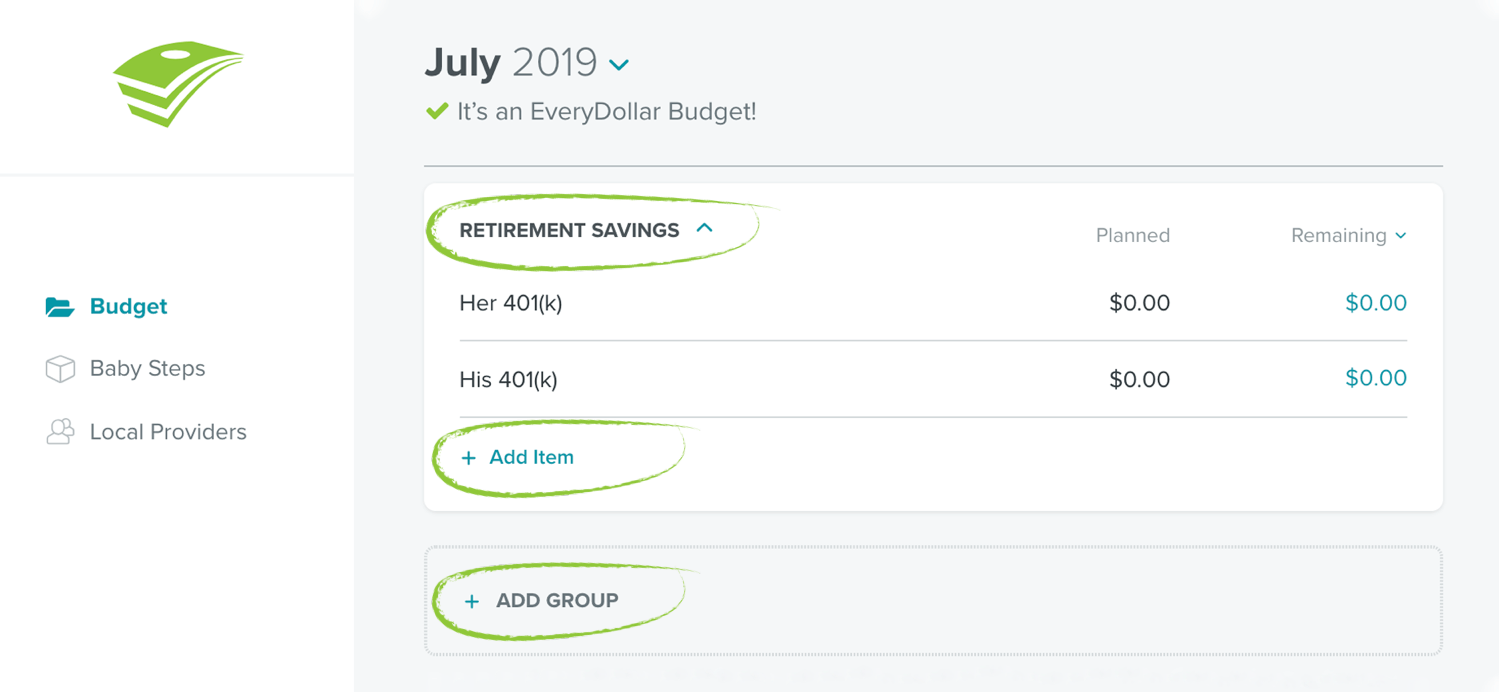
Simply follow these steps:

  • Scroll to the bottom of your budget on the desktop version.
  • Click “ADD GROUP.”
  • Name it something like “Retirement Savings.”
  • Then click “Add Item.”
  • Label your investments.

6. Put raises toward retirement.

When you get a raise at work, first of all—congratulations! We’re throwing confetti in celebration. You can’t see it. But it’s here.

Second of all, point that extra money directly toward boosting your retirement savings. Do not pass go. Do not collect $200. Invest it. You aren’t used to living with it, so you won’t even notice it’s gone.

7. Rein in your spending.

It’s time to get real. With yourself. Review your money habits to see where you can rein in your spending. That gum-buying routine, drive-thru coffee habit, or comical T-shirt obsession could be costing you some serious money that would be way better used toward investing in retirement.

Be honest with yourself about places you overspend or budget lines that could be easily lowered. Here’s one simple solution as an example: Meal planning can save you around $200 a month. That would give an awesome jolt to your retirement savings right there—without a huge sacrifice other than some time being intentional with your grocery planning and shopping.

8. Ditch your credit cards.

The best way to get ahead? Stop getting behind. Now apply that to your money. Using credit cards gets you behind in your finances. All it grows is your debt and your pile of stuff (and that stuff isn’t even really yours). What you want to grow is retirement savings—not debt and junk.

Credit card companies may sign you with a low interest rate, but you better believe they’ll bump it up. Check out these staggering stats. Average interest rates are at 17.14%.1 And Americans are carrying a collective credit card balance of $848 billion.2  

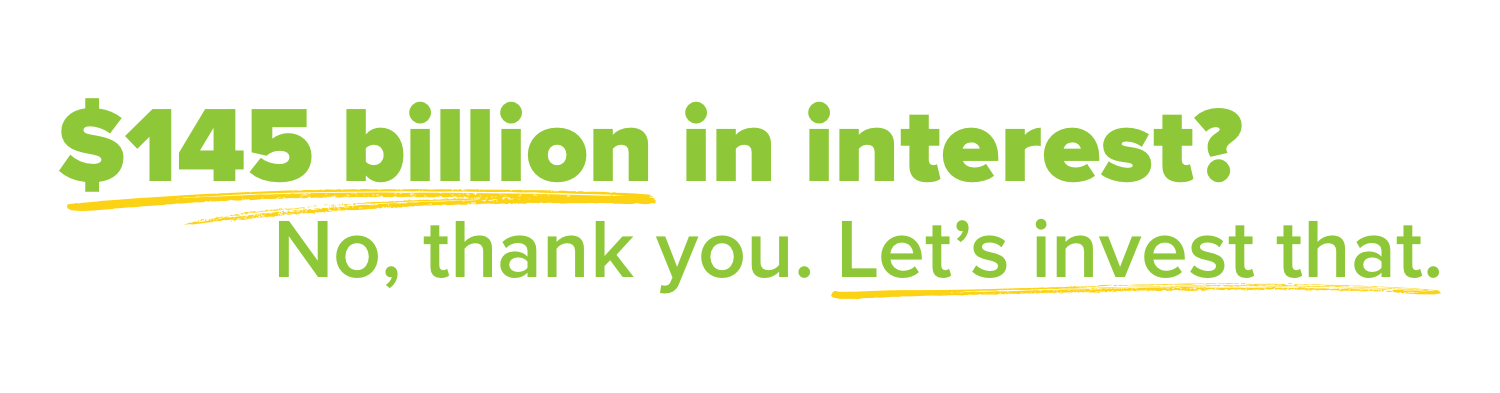
Some quick math (aka asking your smart phone) shows that these companies stand to profit $145 billion in 2019, in interest payments alone! No, thank you. Instead of sending all that money to credit card companies this year, let’s invest it in our futures.

9. Get an investing pro!

Listen, all these details can be confusing for anyone. We suggest you find a reputable investment pro to help you out along the way. These people enjoy investment lingo—but they also know how to break down that lingo for you in a way you can understand. They’ll listen to your preferences and help guide you on your investment journey as you save for the retirement of your dreams.

And those retirement dreams can come true—if you follow the right steps and put your grit to the grindstone. You’ve got the steps, so start moving. 

How to Win With Money in 7 Baby Steps

Step one: Never spend money again. Boom. Done.

Just kidding!

Lucky for you, that’s not the direction of this article. We can show you how to get ahead with your money in just 7 Baby Steps using a plan by money expert Dave Ramsey. So grab an extra pair of socks, friends, because we’re about to knock. Yours. Off.

What Are Dave Ramsey’s Baby Steps?

First let’s answer the burning questions: What are these Baby Steps anyway? Who is this Dave Ramsey? Why should you listen to him?

The Baby Steps were created by Dave Ramsey, a guy who worked his way back from bankruptcy and became a national best-selling author, radio host, and financial expert. These steps to financial stability (and then some) came from his personal experience and time spent teaching others how to save for emergencies, pay off debt for good, and build wealth. They’ve proven themselves time and again as steps that work.

If you want to do better, be better, and live better with money, you’re probably looking at what seems to be a mountain of work to get you there. How do you climb a mountain? How do you reach the top of those Everest dreams? One (baby) step at a time. 

The 7 Baby Steps

Baby Step 1: Save $1,000 for Your Starter Emergency Fund

Only 39% of Americans can pay cash for a $1,000 emergency.(1That means 61% of them are borrowing, selling, or going in debt when life happens in a $1,000 way. And it does. Your car’s catalytic converter crumbles. Your kid busts his chin and needs stiches from the ER. Your washing machine won’t live to spin again. That’s life. Be cash ready.

How: Start saving more money and spending less. You can build up that $1,000 reserve quicker than you think—really. It just takes a little focus and some hard work. Try selling stuff, clipping   coupons, saying no to extra expenses, planning your meals, eating out less, using or selling old gift cards, and downloading money-saving apps. The ways to earn or save $1,000 are nearly endless. Pick a few and get down to saving up.

Baby Step 2: Pay Off All Debt (Except the House) Using the Debt Snowball

Debt’s good for one thing and one thing only: holding you back. But you don’t want to be held back. You want to thrive—and the thriving starts here. You’ve got $1,000 saved up so in the event of an emergency you can use that money instead of going deeper into debt. Now you can attack debt with the vengeance of a knight saving his kingdom from a fire-breathing dragon. Slay that dragon using the debt snowball method. Pay off one debt at a time from smallest to largest, gaining momentum until you deliver the final blow of victory, aka become debt-free.

How: Remember those money-saving tricks from Baby Step 1? Use them and put all that extra cash toward defeating debt. In fact, turn up the heat and see how thrifty you can get while you’re on this step. It’s not forever, and when you’re living free from debt, you’ll look back and see the effort was totally worth it.

Baby Step 3: Save 3–6 Months of Expenses in a Fully Funded Emergency Fund

The debt is gone. Bye bye, debt. Talk to you never. Now, you’re going to beef up that emergency savings fund so it’s strong enough to stand up against bigger problems, like job loss. Figure out how much money you’d need to live for three to six months if your regular income went away. (If you’re a one-income household, aim for that “six months of expenses” mark. Two-income households can go for three.) Save up that amount, and store it in a high-interest savings or money market account with check-writing privileges so you can get to it if you need to.

How: You’re already in a pattern of saving. You clip and tap coupons all the time. You downloaded so many money-saving apps, you have to delete photos of your pup weekly for storage. You started brewing your own coffee at home—and even like it better. Gasp. So keep those money-saving habits going and build your savings into the mighty cash castle it’s meant to be. 

Baby Step 4: Invest 15% of Your Household Income in Retirement

Retirement can seem like tomorrow’s problem. But that kind of thinking will leave you working for the rest of your life. Baby Step 4 demolishes that idea and gets you on the path to the golden years of glory. It’s time to start putting 15% of your gross household income into retirement accounts.

How: Here’s the simple breakdown. When you start this step, first look into your employer’s 401(k). If you have this offering, max out the amount of contributions you can put into this fund—if you’re able—which is $18,500 a year of your own money (not counting the employer match, if you have one). After that, you’ll call in reinforcements such as the Roth IRA, which allows up to $5,500 a year. And remember, that employer match isn’t part of the 15% you’re investing. It’s just a lovely little bonus.

Because it’s so confusing, we suggest you don’t make money moves like that without finding a reputable investment pro. These people enjoy investment lingo but know how to talk to you in a way you can understand. They’ll listen to your preferences and help guide you on your investment journey as you set yourself up to save for the retirement of your dreams.

Baby Step 5: Save for Your Children’s College Fund

No kids? Fully grown and gone kids? You can skip this step and move on to the next. Otherwise, it’s time to start researching and stashing away cash for your kids to further their education. One important note: you’ll be working on Baby Steps 4, 5, and 6 at the same time, but you’ll start them in order.

Why wait to worry about the kids until after you start saving for retirement? One reason is that your kids may or may not go to college—but you will retire. Also, there’s no reason to send them to overwhelmingly expensive universities that’ll leave you unable to pay your bills when you quit working. Putting retirement first is not selfish. It’s wise.

How: First, look at opening an Educational Savings Account (ESA) or 529 college savings fund.

Next, remember this: Going to college without going into debt is possible. Grants and scholarships abound. And your kids should always consider in-state and community college options and—by golly—working throughout school to pay for tuition and fees. Using this Baby Step and all those tactics, your kids can get a diploma without debt.

Baby Step 6: Pay Off Your Home Early

The average American has a monthly mortgage budget line of around $1,400.(2) What if that disappeared, not because of magic, but because you paid off your house—in full. You’ve stopped renting from the lending company, and that home sweet home is yours all yours. It’s nearly impossible to imagine, really. But it’s possible to achieve, really.

How: First, look into refinancing.Do you have a 30-year or adjustable-rate mortgage? Switch to a 15-year. Are rates better? Has your house gone up in value? If so, refinancing could be the game changer for this Baby Step. Another tip is to make one extra house payment per quarter. You’ll pay off your mortgage 11 years earlier and save around $65,000 in interest alone!

Baby Step 7: Build Wealth and Give

Now it’s time to grow your wealth beyond your wildest dreams,—though they won’t seem as wild anymore because you’re going to reach them. And when you do, you’ll not only be living like no one else, you’ll be in a position to give like no one else. Your money won’t be tied up in debt or mortgages or worry. It’ll be free to share with your favorite charities or your church. You can be in a position of easy generosity. What a beautiful feeling this will be.

How: Remember your 401(k) and Roth IRA? Max. Them. Out. As your retirement fund grows, use your remaining wealth to have some fun and help others. Oh, and try not to break our EveryDollar app with all those zeros. Please and thank you.

Why Should I Follow the Baby Steps in This Order?

1. To focus on one goal at a time

As you’re looking to all the money goals in your future, it’s overwhelming—so much to do, so little time. But there is time, and there is a proven path to break up those goals into manageable and achievable pieces that will set you up for success. Because remember: How do you climb a mountain? One (baby) step at a time.

2. To avoid going into debt again

Notice the first three Baby Steps are all about avoiding and paying off debt. They propel you to a debt-free lifestyle like a success rocket. The first $1,000 emergency fund is starter fuel, keeping you going, and still feeling secure, while you eliminate your debt. And that full fund you saved up on Baby Step 3 means you always have cash ready, so you don’t even think about running back to your borrowing ways. 3 . . . 2 . . . 1 . . . blast off to being set against debt.

3. To keep your priorities in check

The moment often seems the most important thing. That thinking can make us pay far too much for our kid’s unicorn-themed birthday party—complete with a four-tiered cake topped with a fondant dancing unicorn and edible glitter rainbows. Teaching your kids the value of saving and dumping debt is a better gift than one you wrap with a giant sparkly bow, no matter how good all those party pics will look on Instagram.

In fact, it’s a better gift for yourself than those fancy gold-trimmed headphones that remind you to do things like take out the trash. These Baby Steps help you set up and focus on a true better-life standard, one that goes beyond social media and into what really matters.

4. To watch and celebrate your progress

When you reach the finish line of one of those Baby Steps, it’s time to celebrate. Seriously. Throw yourself a (low-cost) party! Invite friends. Create a special celebratory family dance. It won’t take the world by storm like the “Macarena,” but it will take your life by storm.

When you walk one Baby Step at a time, you can observe your improvements, applaud your achievements, and know what’s next. Because after one Baby Step comes the next.

Step. Step. Step. Save. Slay. Succeed.

What Should I Do to Get Started With the Baby Steps?

Budget.

Aren’t you glad the answer is simple?

Start with a budget. Today. This is what we call Baby Step 0, and it’s the step you never stop. A budget shows you where your money is actually going, so you can start telling it where you want it to go. A budget sets up a natural accountability with yourself. A budget creates goals.

Knowledge. Empowerment. Accountability. Goals. These are all vital if you’re going to get where you want to be in life and with your money. And they all come when you budget.

So start with a budget.

Design a site like this with WordPress.com
Get started